Tag Archives: CorpGov

DEPOSITS (Companies Act 2013)


After the commencement of present Act of 2013, or more correctly, on issue of Notification by Government of India making Section 73 effective; no company shall invite, accept or renew deposits from the public except in a manner provided under Chapter V of the Act. The chapter V has total four Sections i.e. Section 73 to 76 (both inclusive).

This prohibition does not apply to a banking company, a non – banking financial company as well as any other class of company as specified by the Central government. The Central government may specify any company after consultation with the Reserve Bank of India.

Continue reading

Statement on Annual Return by company Secretary


Under Section 92 of the Companies Act, 2013, every company shall prepare annual return in the prescribed form and signed by a director and the company secretary, or where there is no company secretary, by a company secretary in practice. The annual return, filed by a listed company or, by a company having such paid-up capital and turnover as may be prescribed, shall be certified by a company secretary in practice in the prescribed form, stating that the annual return discloses the facts correctly and adequately and that the company has complied with all the provisions of this Act.

Continue reading

DEBENTURE (Companies Act 2013)


A bond from the Dutch East India Company, dati...

A bond from the Dutch East India Company, dating from 7 November 1623, for the amount of 2,400 florins. (Photo credit: Wikipedia)

Debenture is most important instrument to raise capital for a company. A company use debenture to raise debt capital. Popularly, debenture issued by public sector companies with government approval is called bonds.

Section 2 (30) of the Companies Act, 2013 define inclusively debenture as “debenture” includes debenture stock, bonds or any other instrument of a company evidencing a debt, whether constituting a charge on the assets of the company or not.

Continue reading

REDUCTION OF SHARE CAPITAL


Reduction of capital is a sensitive issue; managerially, financially, economically, and legally. Hence, reduction of capital by a company is always subject to confirmation by the Tribunal on an application made by the company. Company applying for reduction may either be a company limited by share or a company limited by guarantee but having a share capital. Reduction of capital must be approved by special resolution passed by the company. a company may reduce share capital in following manner –

Continue reading

ALTERATION OF SHARE CAPITAL


Every business run on finance and share capital is base finance, hence life blood of a company.

PUBLICATION OF CAPITAL (SECTION 60):

Where any communication or publication of a company contains a statement of the amount of the authorise capital of the company, it shall also contain a statement in an equally prominent position and in equally conspicuous characters of the amount of the capital which has been subscribed and the amount paid – up.

Continue reading

MAJOR CAUTIONS UNDER PUBLIC OFFER (COMPANIES ACT, 2013)


In recent posts, we discussed provisions of Chapter III of the Companies Act, 2013. This is time to discuss major penal provisions in this chapter.

CRIMINAL LIABILITY FOR MIS-STATEMENT IN PROSPECTUS (SECTION 34):

Where a prospectus, issued, circulated or distributed:

a)    includes any statement which is untrue or misleading in form or context in which it is included; or

b)   where any inclusion or omission of any matter is likely to mislead;

Every person who authorises the issue of such prospectus shall be liable under section 447 i.e. fraud.

Continue reading

ALLOTMENT OF SECURITIES (Companies Act 2013)


In recent posts, we have discussed matters related to prospectus. In this post we will discuss, matters related to issue and allotment of securities following public offer.

SECURITIES IN DEMATERIALISED FORM (SECTION 29):

Under this section;

  1. Every company making public offer; and
  2. Such other class or classes of companies as may be prescribed

shall issue the securities only in the dematerialised form.

When any company issue its securities in dematerialised form, provisions of the Depositories Act, 1996 and regulations made under that Act shall be applicable.

There is no bar for any other company to issue its securities in any form. Any other company may convert its securities into dematerialised form.

Continue reading

Effective Provisions of Companies Act, 2013 as on 12th September 2013


On 30th August 2013 (Bhadrapada 8, 1935 Saka), Ministry of Law and Justice issued a notification regarding the Companies Act, 2013 immediately after it received assent of President of India. Only section 1 of the Act of 2013 came into effect from that day. Section 1 as usual deals with short title, Extent, commencement and application.

Earlier Act of 1956 was applicable to whole of India with some modification related to Indian State of Nagaland, but not applicable Indian state of Sikkim. Act of 2013 is applicable to whole of India including Sikkim and without any exception to any state. Sub – section 4 of Section 1 of Act of 2013 lists out some exception regarding particular classes of companies. However, Act of 2013 is not made effective to Sikkim as on 12th September 2013.

Continue reading

VARIANTS OF PROSPECTUS (Companies Act, 2013)


In our last blog post Prospectus (Companies Act 2013) , we discussed provisions related to prospectus. We will continue our study in this post.

ADVERTISEMENT OF PROSPECTUS (SECTION 30):

When a company issue an advertisement of prospectus, the advertisement shall specify contents of its memorandum; the objects, the liability of members, amount of share capital, name of signatories, and number of shares subscribed for by these signatories and its capital structure.

SHELF PROSPECTUS (SECTION 31):

Any class of company may file a shelf prospectus with the Registrar of Companies at the stage of first offer of securities.

Continue reading

Board Structure in Central Public Sector Enterprises


Central Public Enterprises in India are not simple business enterprises, but fall under definition of “State” under Article 12 of the Constitution of India. They are subject to Writ Jurisdiction. The Right to Information Act, 2005 is applicable to them.

The Law governing Central Public Sector Enterprises are complex mix of Guidelines/instructions issued by Department of Public Enterprises (DPE), the Companies Act, 1956 regulations of Comptroller and Auditor General of India (CAG), Central Vigilance Commission, and administrative Ministry.

Continue reading

GOVERNANCE OF REGULATOR: FSLRC REPORT-III


(…Continue from last two posts)

Role of the review committee

The Commission recommends that the non-executive members of the board of a regulator form a special committee called the review committee. This committee will discharge the following functions:

Continue reading

GOVERNANCE OF REGULATOR: FSLRC REPORT-II


( …continue from last post)

Appointment conditions for board members

1. Duration of employment: All members of a board (including the chairperson) would have a fixed term of five years, subject to a retirement age for executive members. The age of retirement for executive members must be equivalent to the age of retirement for the equivalent senior-most Government positions.

Continue reading

GOVERNANCE OF REGULATOR: FSLRC REPORT-I


Governance responsibilities are key element of any deliberation since last twenty years. Form United Nations to our families all has valid concerns about good governance and responsible behaviour. Corporate governance is just a reflection of this ongoing improvement process of governance of human society.

Present report of Financial Sector Legislative Reform Commission headed by Justice B N Srikrishna is just another but very powerful far – reaching discussion on corporate governance. The report in its first part “analysis and recommendations” very extensively discussed issues related to governance. In second part of report, draft code comprehensively proposed a law with an eye on good governance of proposed regulators.

Continue reading

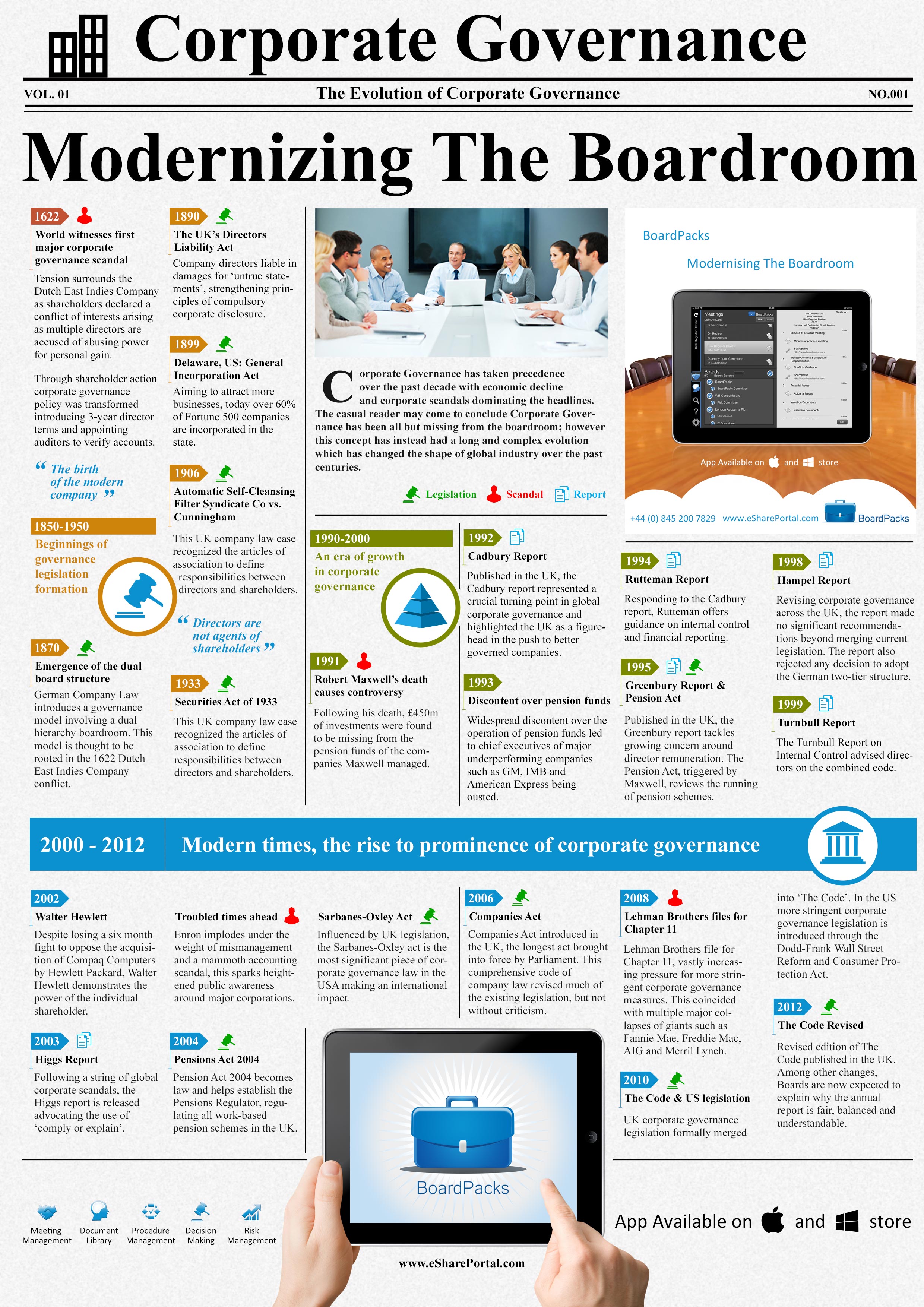
EVOLUTION OF CORPORATE GOVERNANCE


When was world first corporate governance scandal witnessed?

Recently, I received a very good info-graphic on the evolution of corporate governance. This info – graphic cover many remarkable events in the process. I had put a link to the web – site of presenter of this info – graphic to give due credit to them.

Please share your views and comments on this info – graphic.

The Evolution of Corporate Governance, source  www.eSharePortal.com

The Evolution of Corporate Governance, source http://www.eSharePortal.com

Please note: this blog post is not a professional advice but general information about the subject covered here. In case, you have specific query, please seek professional advice or contact author.

I appreciate if readers share this post on social media with friends and colleagues. This will be my remuneration from your side. I welcome your comments and feedback.

Corporate Social Responsibility under Companies Act 2013


UPDATE: on 30th August 2013: Companies Bill 2012 became the Companies Act, 2013 (Act 18 of 2013).

The provision related to Corporate Social Responsibility under present Clause  Section 135 of Companies Bill 2012 Act 2013 applies to all companies; listed, unlisted, public, private, one – person subject to limitation based on its net worth, turnover and net profit. These threshold limits are:

Continue reading

RTI Reply on Working of MCA21 Portal in 2012 – 13


I filed an application for Information of period from 1st April 2012 to 31st March 2013 about working of MCA21 portal. My question was:

Description of the information required:

1. Current User Capacity of MCA21 Portal,

2. Number of Month – wise Log – in on MCA21 portal from 1st April 2012 to 31st March    2013

3. Total Month – wise time – period, during 1st April 2012 to 31st March 2013, when MCA21 Portal was not working due to Maintenance, Updating, Production release, upgrades, switchovers, switchback drills or other official Reasons; and details thereof,

4. Total month – wise time period, during 1st April 2012 to 31st March 2013, when MCA21 Portal put notice like “Large numbers of users are logged in MCA21 portal. Kindly try after some time.”


I received this reply from Ministry of Corporate Affairs, which is also embedded here. Please read and share your views on comment section of this blog post.

Interests of Director and Related Party Transactions


UPDATE: on 30th August 2013: Companies Bill 2012 became the Companies Act, 2013 (Act 18 of 2013).

DISCLOSURE OF INTEREST BY DIRECTOR (SECTION 184, SUB SECTION 1):

Every director shall disclose his concern or interest in any company or companies or bodies corporate, firms, or other association of individuals which shall include the shareholdings, in such manner as may be prescribed. Such disclosure shall be made on three particular point of time:

(i)           At the first meeting of the Board in which he participates as a director;

(ii)          At the first meeting of the Board in every financial year; and

(iii)         Whenever there is any change in the disclosures already made, then at the first Board meeting held after such change.

Continue reading

BOARD MEETING UNDER COMPANIES ACT 2013


UPDATE: on 30th August 2013: Companies Bill 2012 became the Companies Act, 2013 (Act 18 of 2013).

The Board of Directors is most powerful body in a company. The Corporate governance is until now is governance of the Board.

The Companies Bill 2012 has dedicated chapter i.e. Chapter XII dealing with Board meetings and its power.  In this blog I will discuss Board Meetings and in a future post power of Board of Directors.

Continue reading