FORMATION OF A COMPANY


UPDATE: on 30th August 2013: Companies Bill 2012 became the Companies Act, 2013 (Act 18 of 2013).

Section 3, 4 and 5 of the Companies Bill, 2012 Act 2013

In my last post, I discussed definition of companies and classes.

FORMATION OF COMPANY (SECTION 3):

A company may be formed for any lawful purpose by:

(a)    Seven or more persons as public company;

(b)   Two or more persons as private company;

(c)    One person as One Person Company

By subscribing names to a memorandum and complying other requirements.
Continue reading

Quotes from Companies Bill debate in Rajya Sabha


UPDATE: on 30th August 2013: Companies Bill 2012 became the Companies Act, 2013 (Act 18 of 2013).

For every new law, legislative intent, which show it in debates taken place in Parliament, become important. These debates offer a guide while drafting subordinate legislation. There are many questions about future rules and regulations. I, here, compiled some important quotes from this debates from Rajya Sabha.[i][ii][iii]

Continue reading

The Company under the Companies Act 2013


UPDATE: on 30th August 2013: Companies Bill 2012 became the Companies Act, 2013 (Act 18 of 2013).

This is my first post after passing of the Companies Bill, 2012 by Rajya Sabha on 8th August 2013. Lok Sabha have already passed this Bill, earlier on 18th December 2012. The Bill is just one signature away from being an Act or two-three step away from come to be in forced by Notification.

Here, I try to study briefly some definitions related to companies under present Bill [Now the Companies Act, 2013]. Readers may please add their inputs in comment section of this post.

Continue reading

Board Structure in Central Public Sector Enterprises


Central Public Enterprises in India are not simple business enterprises, but fall under definition of “State” under Article 12 of the Constitution of India. They are subject to Writ Jurisdiction. The Right to Information Act, 2005 is applicable to them.

The Law governing Central Public Sector Enterprises are complex mix of Guidelines/instructions issued by Department of Public Enterprises (DPE), the Companies Act, 1956 regulations of Comptroller and Auditor General of India (CAG), Central Vigilance Commission, and administrative Ministry.

Continue reading

GOVERNANCE OF REGULATOR: FSLRC REPORT-III


(…Continue from last two posts)

Role of the review committee

The Commission recommends that the non-executive members of the board of a regulator form a special committee called the review committee. This committee will discharge the following functions:

Continue reading

NON – EXISTENT INDIAN


Every mainstream Indian have at least one document who can serve proof of his identity and address. It may be your ration card, voter identity card, driving license or high-profile passport. These documents are your key to gain entry to any place, get reservation in train, open bank accounts, secure phone connection, and even to claim compensation in case of misfortune like accident or death.

We may have multiple identities, true and false identities as government always claim about false ration cards.

Continue reading

GOVERNANCE OF REGULATOR: FSLRC REPORT-II


( …continue from last post)

Appointment conditions for board members

1. Duration of employment: All members of a board (including the chairperson) would have a fixed term of five years, subject to a retirement age for executive members. The age of retirement for executive members must be equivalent to the age of retirement for the equivalent senior-most Government positions.

Continue reading

GOVERNANCE OF REGULATOR: FSLRC REPORT-I


Governance responsibilities are key element of any deliberation since last twenty years. Form United Nations to our families all has valid concerns about good governance and responsible behaviour. Corporate governance is just a reflection of this ongoing improvement process of governance of human society.

Present report of Financial Sector Legislative Reform Commission headed by Justice B N Srikrishna is just another but very powerful far – reaching discussion on corporate governance. The report in its first part “analysis and recommendations” very extensively discussed issues related to governance. In second part of report, draft code comprehensively proposed a law with an eye on good governance of proposed regulators.

Continue reading

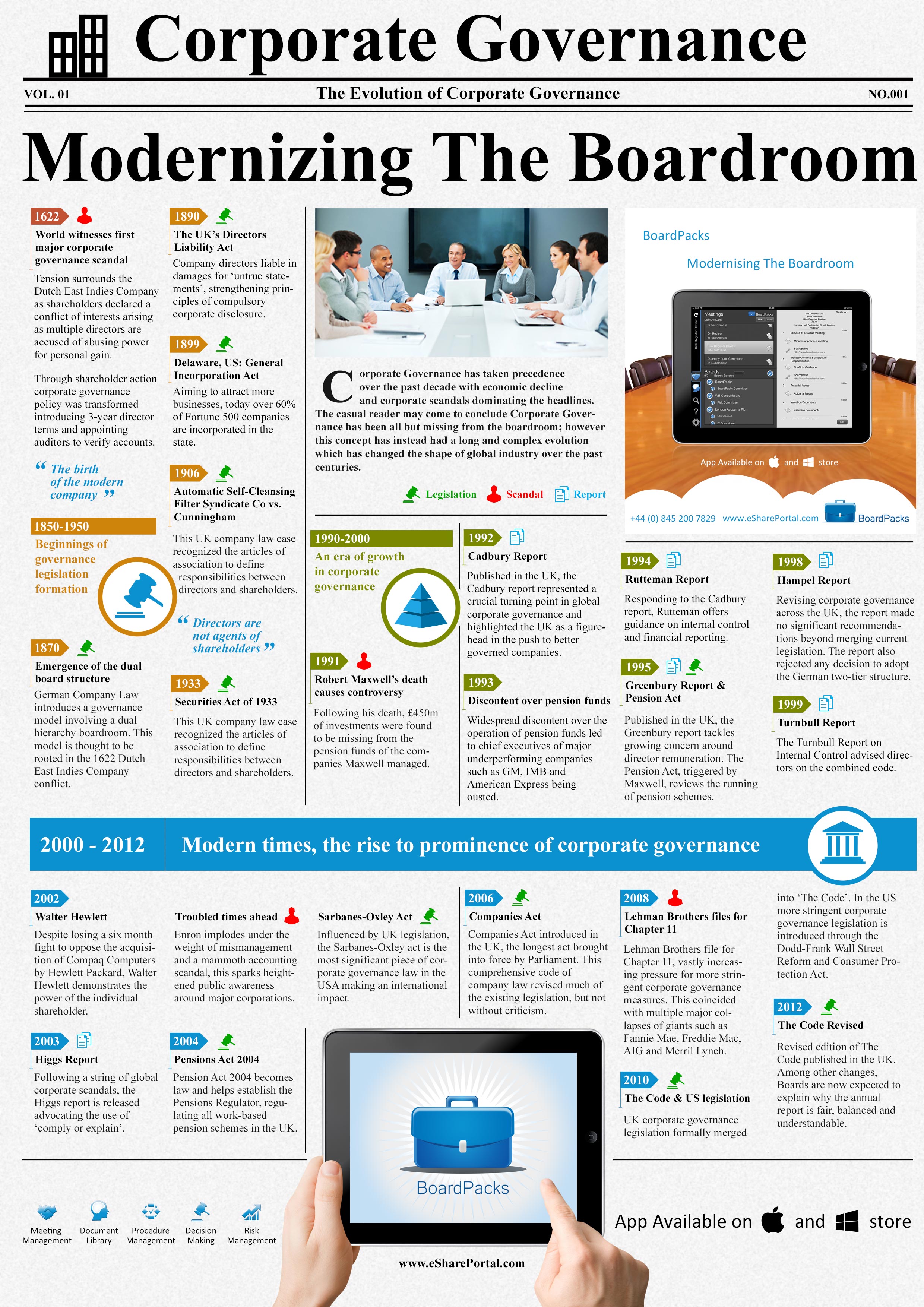
EVOLUTION OF CORPORATE GOVERNANCE


When was world first corporate governance scandal witnessed?

Recently, I received a very good info-graphic on the evolution of corporate governance. This info – graphic cover many remarkable events in the process. I had put a link to the web – site of presenter of this info – graphic to give due credit to them.

Please share your views and comments on this info – graphic.

The Evolution of Corporate Governance, source  www.eSharePortal.com

The Evolution of Corporate Governance, source http://www.eSharePortal.com

Please note: this blog post is not a professional advice but general information about the subject covered here. In case, you have specific query, please seek professional advice or contact author.

I appreciate if readers share this post on social media with friends and colleagues. This will be my remuneration from your side. I welcome your comments and feedback.

Corporate Social Responsibility under Companies Act 2013


UPDATE: on 30th August 2013: Companies Bill 2012 became the Companies Act, 2013 (Act 18 of 2013).

The provision related to Corporate Social Responsibility under present Clause  Section 135 of Companies Bill 2012 Act 2013 applies to all companies; listed, unlisted, public, private, one – person subject to limitation based on its net worth, turnover and net profit. These threshold limits are:

Continue reading

PENALTIES RELATED TO OPPRESSION & MISMANAGEMENT UNDER COMPANIES ACT 2013


UPDATE: on 30th August 2013: Companies Bill 2012 became the Companies Act, 2013 (Act 18 of 2013).

In my last two post, I wrote about “Oppression and Mismanagement” and “Class Action” under the Companies Bill 2012. Section 246 makes it necessary for me to discuss Sections 337 to 341 of the Bill. These sections are natural extension to provisions related to “Oppression and Management” and “Class Action” under Chapter XVI.

Continue reading

CLASS ACTION IN COMPANIES ACT, 2013


UPDATE: on 30th August 2013: Companies Bill 2012 became the Companies Act, 2013 (Act 18 of 2013).

In continuation with my last blog post on Oppression and Mismanagement; I am reading Class Action under Clause 245 of the Bill. Provisions relating to Class Action are under Chapter XVI of the Companies Bill, 2012 and basically target to achieve investor protection in a limited manner and on an experimental basis.

[Law discussed in this post was valid till 8 May 2019 and have academic and Historic value.]

Continue reading

OPPRESSION & MISMANAGEMENT UNDER COMPANIES ACT 2013


UPDATE: on 30th August 2013: Companies Bill 2012 became the Companies Act, 2013 (Act 18 of 2013).

Class Action is one of the youngest additions to Indian jurisprudence particularly, in Indian Corporate Jurisprudence. Class Action aims to prevent Oppression and Mismanagement in Companies. The Provisions relating to Oppression and Mismanagement are in Chapter XVI of the Companies Bill, 2012.

In this post, I will cover Section 241 – 244 which deals with normal provisions.

In next post, I will discuss Section 245 dealing with Class Action and after that Section 246 read with Section 373 to 341.

Continue reading

RTI Reply on Working of MCA21 Portal in 2012 – 13


I filed an application for Information of period from 1st April 2012 to 31st March 2013 about working of MCA21 portal. My question was:

Description of the information required:

1. Current User Capacity of MCA21 Portal,

2. Number of Month – wise Log – in on MCA21 portal from 1st April 2012 to 31st March    2013

3. Total Month – wise time – period, during 1st April 2012 to 31st March 2013, when MCA21 Portal was not working due to Maintenance, Updating, Production release, upgrades, switchovers, switchback drills or other official Reasons; and details thereof,

4. Total month – wise time period, during 1st April 2012 to 31st March 2013, when MCA21 Portal put notice like “Large numbers of users are logged in MCA21 portal. Kindly try after some time.”


I received this reply from Ministry of Corporate Affairs, which is also embedded here. Please read and share your views on comment section of this blog post.

Interests of Director and Related Party Transactions


UPDATE: on 30th August 2013: Companies Bill 2012 became the Companies Act, 2013 (Act 18 of 2013).

DISCLOSURE OF INTEREST BY DIRECTOR (SECTION 184, SUB SECTION 1):

Every director shall disclose his concern or interest in any company or companies or bodies corporate, firms, or other association of individuals which shall include the shareholdings, in such manner as may be prescribed. Such disclosure shall be made on three particular point of time:

(i)           At the first meeting of the Board in which he participates as a director;

(ii)          At the first meeting of the Board in every financial year; and

(iii)         Whenever there is any change in the disclosures already made, then at the first Board meeting held after such change.

Continue reading

Spam Fraud (Nigerian Scam)


A Corporate Law Consultant or Practicing Company Secretary always subscribe for all kind of news alert and updates from regulatory authorities. Reserve Bank of India is one of the most fatal subscriptions. Oh no! They not send us virus but all fraudsters love to be their look – like.

Even though, I have all regular E – mail ids of Reserve Bank of India in my contact list. Therefore, I am able to delete all suspicious mail looking similar to that of Reserve Bank of India. Last year, I receive a mail form one such mail and opened. This was looking spam as they are asking some details which are not usually asked by authorities through E – mail but through Public Announcement using all media coverage.

Continue reading

BOARD MEETING UNDER COMPANIES ACT 2013


UPDATE: on 30th August 2013: Companies Bill 2012 became the Companies Act, 2013 (Act 18 of 2013).

The Board of Directors is most powerful body in a company. The Corporate governance is until now is governance of the Board.

The Companies Bill 2012 has dedicated chapter i.e. Chapter XII dealing with Board meetings and its power.  In this blog I will discuss Board Meetings and in a future post power of Board of Directors.

Continue reading

A GROUP WE-CHAT FOR WE-INDIAN


Whenever I think to meet all person of my choice from human history and present, I always have a very long list on different aspect. Meeting a person may be to learn, to pay respect, to get photo opportunity and so on.  This is a time of technology. This classic question has since been changed after introduction of chatting.

Continue reading

Drafting of Future Laws


By the time this write – up reach to your hand, you may have read Report of Financial Sector Legislative Reform Commission and draft Indian Financial Code. Now, there is a high focus on this proposed law and deliberations are in plenty.

I call your attention to Chapter 2.3 of the report! This is titled “Approach to Drafting” – a very good read for all student of drafting, which we are.

Continue reading