Institute of Company Secretaries of India came out with Draft Guideline Guidelines for Use of Individual Logo by Company Secretaries in Practice.
Para 4 of the Draft Guidelines deals with “The Individual LOGO”. I have some observations here:

Institute of Company Secretaries of India came out with Draft Guideline Guidelines for Use of Individual Logo by Company Secretaries in Practice.
Para 4 of the Draft Guidelines deals with “The Individual LOGO”. I have some observations here:
| Recently Institute of Company Secretaries of India send a mail to all its members for feedback on daily CS updates. Here is my copy of feedback. Readers, please send your feedback if not send earlier. |
Late CS Bipin S. Acharya used to say that Secretarial Audit will confer this professional its legitimate dues and legal recognition for secretarial audit his life mission. Recently, the Companies Act 2013 introduced secretarial audit first time in India under legal mandate. However, there is suspicious among company secretaries about its future as earlier compliance certificates became useless piece of paper. The Institute of Company Secretaries of India seems to share same apprehension and working to address all issues. However, Institute has own limitations. Presently, we have about 9500 companies covered under compulsory secretarial audit and there are about 6500 company secretaries in practice.
Posted in Chapter XIII - CA2013, Companies Act 2013, Company Secretary, CorpGov, Governance and Responsibility, Institute of Company Secretaries of India - ICSI, Secretarial Audit
Tagged Annual Return Certification, ICSI, India, Institute of Company Secretaries of India, Secretarial Audit, The Companies Act 2013
I have done a survey earlier on working of MCA21 and wrote a post based on that survey. You can find that post here. Based on these result, I have an RTI reply discussed here. Now, I am here with … Continue reading
Professional life is tightrope balance of professional commitments, personal relations and oneself. This is tougher for professional executives. They have near impossible commitments, near broken relations and almost lost themselves. This is all about developed professional skills, time management, stress management and skilled use of latest technology. Technological development is most enabling factors in a professional life.
Posted in Company Secretary, Governance and Responsibility, Truth of Our Time
Tagged Professional, Technology
Dear Stakeholders of Corporate India,
As a most vibrant corporate community of the world, you are aware or recent unwelcome development related to corporate India like Satyam, Sahara and Saradha. These developments raised strong concern among us and Parliament of India as well. This reflects in core principles of the Companies Act, 2013. India has some of the best corporate governance and social responsibility norms in the world.
Institute of Company Secretaries of India has mailed an “appeal” to its members and student on 1st April 2014. This was not an April Fool Prank. This letter is in public domain and is a public document.
In following paragraph, we will discuss this “appeal”:
Continue reading
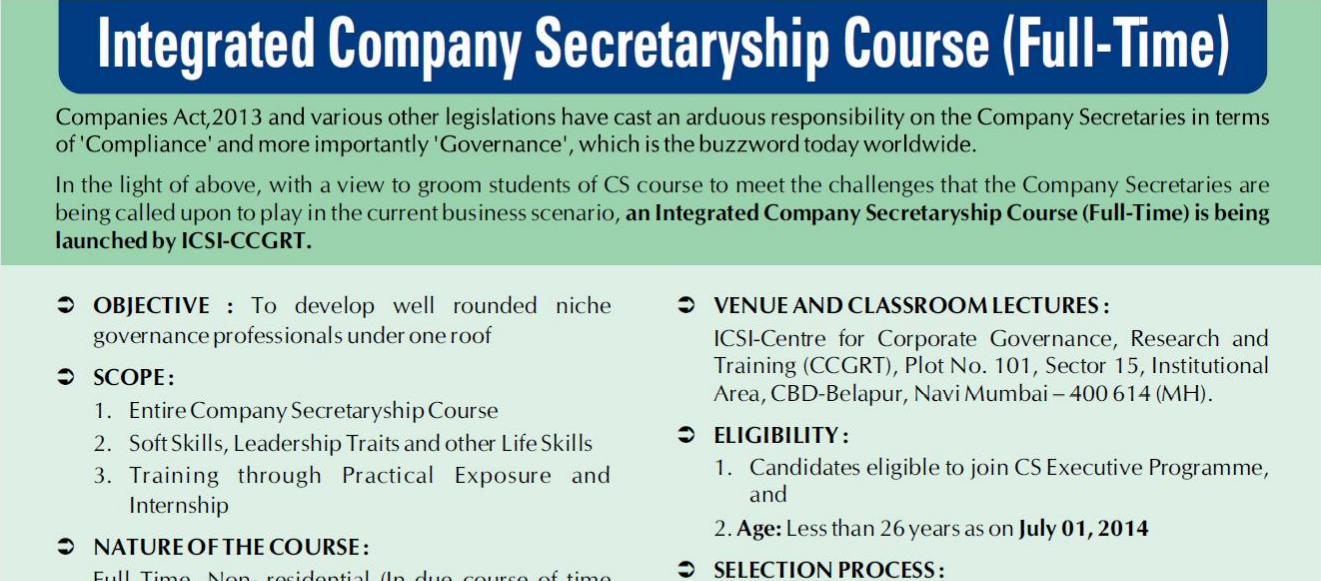
The Institute of Company Secretaries of India has announces an integrated Company Secretaryship Course – Full Time on its web – site Recently. Readers may find details at the following link:
https://www.icsi.edu/portals/0/INTEGRATED_COMPANY_SECRETARYSHIP_COURSE_FULL_TIME.pdf
1. What is this integrated Company secretaryship course – Full time?
2. Was any response invited from stakeholders particularly from members?
3. Is it meant to create a class of full time students against present part – time students?
4. What measure have been taken to ensure that Industry will take all company secretaries as equal irrespective of course chosen – Full time or part time?
5. Why is there only one year training period there for these students against two years for general part time students? Is not it meant creating a separate class among students itself?
Readers may leave comments in the Comment section here under.
“Company Secretary” has started a long journey form clerk to manager, general manager, decision maker, key managerial personnel to its full avatar of governance professional.
Depending upon knowledge, experience and expertise, all members of same profession may not be on same glorified height. Some may still be a clerk and some other may be on top of ladder. This all may depend upon our risk appetite of individual and his willingness to accept challenges. This will also depend upon the challenges offered to the professional.
Under Section 92 of the Companies Act, 2013, every company shall prepare annual return in the prescribed form and signed by a director and the company secretary, or where there is no company secretary, by a company secretary in practice. The annual return, filed by a listed company or, by a company having such paid-up capital and turnover as may be prescribed, shall be certified by a company secretary in practice in the prescribed form, stating that the annual return discloses the facts correctly and adequately and that the company has complied with all the provisions of this Act.
Posted in Chapter VII – CA2013, Companies Act 2013, Company Secretary, Governance and Responsibility, Institute of Company Secretaries of India - ICSI
Tagged Annual Return, class-action suits, Company Secretaries in Practice, CorpGov, CorpLaw, Corporate Governance, Corporate Law, Fraud, Institute of Company Secretaries of India, Members and Shareholders
I am company secretary by profession and write blogs as a passion. This was my dream profession, when I started my study to be a company secretary and still is. I love to look into not only law of lands affecting my clients but products which can help me professionally.
Recent time, there is a lot of talk about corporate governance and therefore board meeting to be conducted electronically (general meetings as well of course). Section 173 (2) clearly say, “the participation of directors in a meeting of the Board may be either in person or through video conferencing or other audio-visual means, as may be prescribed, which are capable of recording and recognising the participation of the directors and of recording and storing the proceedings of such meetings along with date and time.”
Employee’s welfare is also a matter corporate social responsibility for all body corporate. During debate on corporate social responsibilities we heard a lot from all quarters.
Principle 3 of National Voluntary Guideline on Social, Environment, & Economic Responsibilities of Business issued by Ministry of Corporate Affairs say, ”Businesses should promote the well being of all Employees.” On page 17 of this guideline, it is mentioned that “…strongly believe that addressing health issues significantly contributes to the sustainability of their business operations and especially the health and welfare of their employees.” There is separate guideline issued by Government for Central Public sector Enterprises.
As a stakeholder, we have interest in measures taken by professional bodies under Ministry of Corporate Affairs. It is noteworthy to note, these professional bodies are very instrumental to spread awareness about corporate social responsibilities on behalf of government. I filed applications under three professional bodies and asked same questions:
Posted in Company Secretary, CorpGov, CSR, Governance and Responsibility, Institute of Company Secretaries of India - ICSI, Truth of Our Time
Tagged CorpGov, CorpLaw, Corporate, Corporate Governance, CSR, Employees Welfare, Health, ICAI, ICSI, India, Institute of Chartered Accountants of India, Institute of Company Secretaries of India, institute of Cost Accountants of India, Ministry of corporate affairs, RTI
(UPDATE: on 30th August 2013: Companies Bill became the Companies Act, 2013 (Act 18 of 2013). This post Updated Accordingly).
The Companies Law is one of the most important and comprehensive legislation after the Constitution of the Nation. This directly indirectly affects all citizens. This bill has 470 Sections and 7 Schedules. This bill provides basis and flexible framework. The Bill has leaved so many matters for subordinate legislation; rules, regulation, circulars etc.
This is very clear this time that there are remarkable scope for professionals, practicing professionals particularly Company Secretaries in practice. We will know real position when all rules and regulations notified after passing and notification of present bill as an Act.
Presently we may discuss, role of Company Secretaries under Companies Bill, 2012 as it is the Companies Act, 2013.
Law gives legal status to Company Secretary but not business feasibility for the appointment of a Company Secretary in employment of an organisation. Business feasibility could be measured in term of value addition to the organisation not legal addition to the organisation. The value addition may be in form of increased profitability, wealth creation or confidence building among its stakeholders. These stakeholders measure success not in financial terms but through confidence towards an organisation amongst them.
We have completed many stages; clerk, manager, general manager, decision maker, managerial personal, Key managerial personnel and next step the conscience keeper. Every height we gain always stands on a solid foundation of a concrete mix customised for individual need. So we need to look into basic foundation of our profession. The litmus test to judge strength of basic foundation of any profession is not its education, crowd of its student, number of its members, this and that legal recognition, written ethical value codes and International codifications but confidence put by its real paymaster, the stakeholders.
The Institute of Company Secretaries of India organized its annual ritual called national convention on October 4, 5 & 6, 2012 at Aamby Valley, District Pune, Maharashtra on theme “Vision 2020: Transform, Conform and Perform”. This was my second national convention. I am very happy to note that my article “Keep Conscience Awaken: Blow Whistle” was published in the souvenir of the convention. My enthusiasm could be reflected from my delegate number 203 out of 1200 registered delegates while I already have more than 40 credit hours of continuing professional education program.
E-Governance is application of Information and Communication Technology (ICT) for delivering government services, exchange of information communication transactions, integration various stand-one systems and services between Government-to-Citizens (G2C), Government-to-Business(G2B), Government-to-Government( G2G) as well as back office processes and interactions within the entire government frame-work. [i] E-Governance is beneficial to provide a corruption free administrative service to citizens and other stakeholders. The essence of E-governance is to serve intended person easily and faster. There should be an auto-response system to support the essence of E-governance, whereby the Government realizes the efficacy of its governance. Best form of E-governance cuts down on unwanted interference of too many layers while delivering governmental services.
There are many electronic governance projects run by government of India. The target users of all these projects come from different segment of public and have different education standards. When these e-governance projects target grassroots level, its success depend not only designers and developers of such electronic governance projects but much upon cooperation and understanding of its end users. Such project always faces critical evaluation by its users and scholars.
The Ministry of Corporate Affairs (MCA), Government of India, has initiated the MCA21 project, which enables easy and secure access to MCA services in an assisted manner for corporate entities, professionals, and general public. The MCA21 project is designed to fully automate all processes related to enforcement and compliance of the legal requirements under the Companies Act, 1956 Government within a day’s time.[ii] Majority of stake holders of this project are professionals and business houses.
Posted in Companies Act 2013, Company Secretary, Governance and Responsibility, Truth of Our Time
Tagged CorpLaw, e-Governance, India, MCA21
In last 20 years after initiation of economic reforms, India particularly corporate India has moved far ahead to start a new flight towards untouched horizons. We are surviving in a time of dynamic transformations through technological advancement, regulatory rationalisation, progressive professionalism, democratic transformation and sustainable development in our society. In recent developments, transformation of leadership of democratic institutions toward participatory solidarity of all societal stakeholders is evident. There are evidences of many streams of thought and developments in society but there are many new developments, whose time is just knocking the door. Our corporate environment is not left out but is part and parcel of this silent revolution. These transformations in our society are bound to affect all vistas of our life and corporate sector as well. We are very fortunate to be a part of this transformation and we have tremendous opportunity to be a carrier of this transformation. We should understand this revolutionary time and keep pace.

This work is licensed under a Creative Commons Attribution-NonCommercial 3.0 Unported License.


 AishMGhrana