Tag Archives: CorpLaw

Board Structure in Central Public Sector Enterprises


Central Public Enterprises in India are not simple business enterprises, but fall under definition of “State” under Article 12 of the Constitution of India. They are subject to Writ Jurisdiction. The Right to Information Act, 2005 is applicable to them.

The Law governing Central Public Sector Enterprises are complex mix of Guidelines/instructions issued by Department of Public Enterprises (DPE), the Companies Act, 1956 regulations of Comptroller and Auditor General of India (CAG), Central Vigilance Commission, and administrative Ministry.
Continue reading

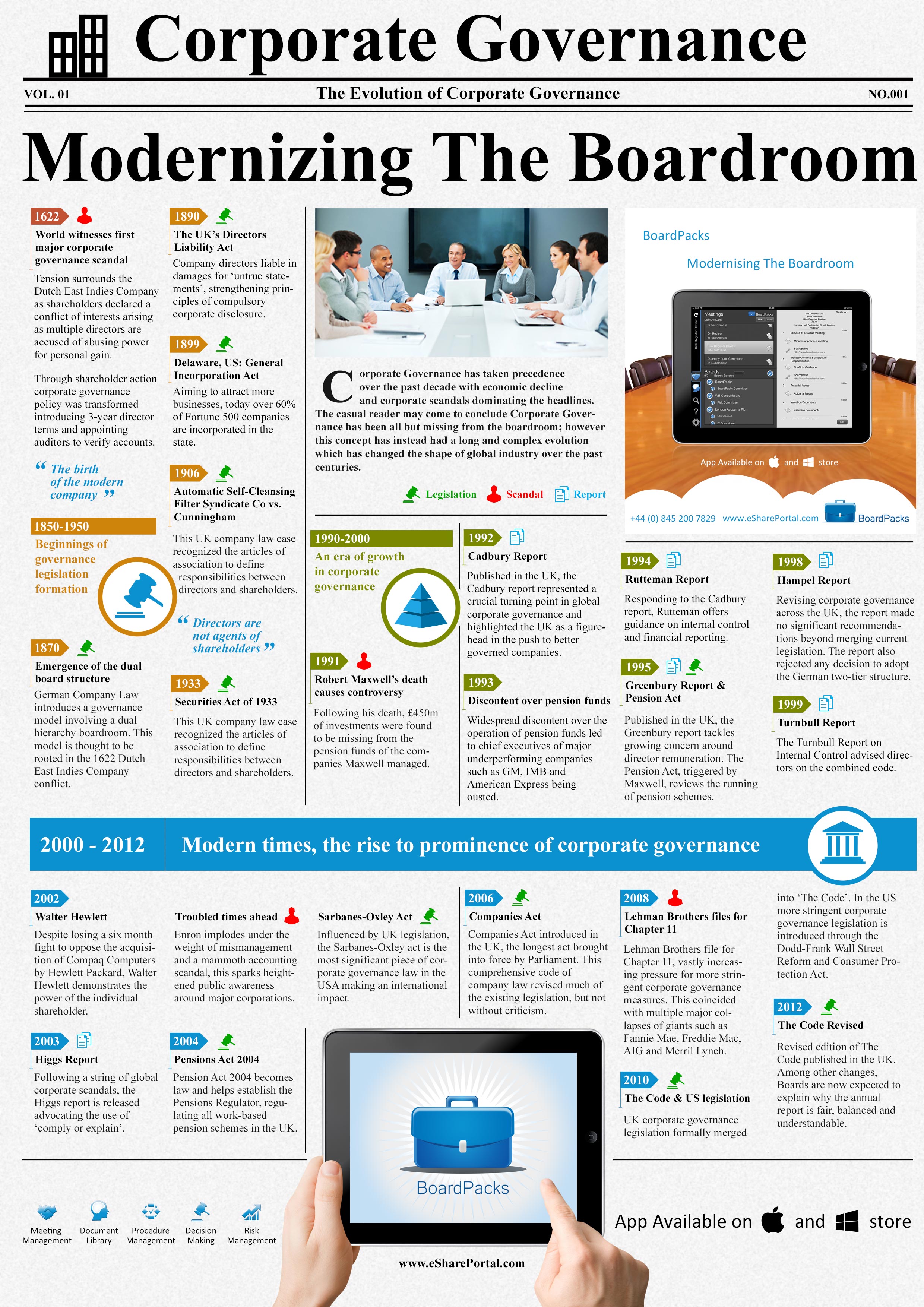
EVOLUTION OF CORPORATE GOVERNANCE


When was world first corporate governance scandal witnessed?

Recently, I received a very good info-graphic on the evolution of corporate governance. This info – graphic cover many remarkable events in the process. I had put a link to the web – site of presenter of this info – graphic to give due credit to them.

Please share your views and comments on this info – graphic.

The Evolution of Corporate Governance, source  www.eSharePortal.com

The Evolution of Corporate Governance, source http://www.eSharePortal.com

Please note: this blog post is not a professional advice but general information about the subject covered here. In case, you have specific query, please seek professional advice or contact author.

I appreciate if readers share this post on social media with friends and colleagues. This will be my remuneration from your side. I welcome your comments and feedback.

Corporate Social Responsibility under Companies Act 2013


UPDATE: on 30th August 2013: Companies Bill 2012 became the Companies Act, 2013 (Act 18 of 2013).

The provision related to Corporate Social Responsibility under present Clause  Section 135 of Companies Bill 2012 Act 2013 applies to all companies; listed, unlisted, public, private, one – person subject to limitation based on its net worth, turnover and net profit. These threshold limits are:

Continue reading

PENALTIES RELATED TO OPPRESSION & MISMANAGEMENT UNDER COMPANIES ACT 2013


UPDATE: on 30th August 2013: Companies Bill 2012 became the Companies Act, 2013 (Act 18 of 2013).

In my last two post, I wrote about “Oppression and Mismanagement” and “Class Action” under the Companies Bill 2012. Section 246 makes it necessary for me to discuss Sections 337 to 341 of the Bill. These sections are natural extension to provisions related to “Oppression and Management” and “Class Action” under Chapter XVI.

Continue reading

CLASS ACTION IN COMPANIES ACT, 2013


UPDATE: on 30th August 2013: Companies Bill 2012 became the Companies Act, 2013 (Act 18 of 2013).

In continuation with my last blog post on Oppression and Mismanagement; I am reading Class Action under Clause 245 of the Bill. Provisions relating to Class Action are under Chapter XVI of the Companies Bill, 2012 and basically target to achieve investor protection in a limited manner and on an experimental basis.

[Law discussed in this post was valid till 8 May 2019 and have academic and Historic value.]

Continue reading

OPPRESSION & MISMANAGEMENT UNDER COMPANIES ACT 2013


UPDATE: on 30th August 2013: Companies Bill 2012 became the Companies Act, 2013 (Act 18 of 2013).

Class Action is one of the youngest additions to Indian jurisprudence particularly, in Indian Corporate Jurisprudence. Class Action aims to prevent Oppression and Mismanagement in Companies. The Provisions relating to Oppression and Mismanagement are in Chapter XVI of the Companies Bill, 2012.

In this post, I will cover Section 241 – 244 which deals with normal provisions.

In next post, I will discuss Section 245 dealing with Class Action and after that Section 246 read with Section 373 to 341.

Continue reading

RTI Reply on Working of MCA21 Portal in 2012 – 13


I filed an application for Information of period from 1st April 2012 to 31st March 2013 about working of MCA21 portal. My question was:

Description of the information required:

1. Current User Capacity of MCA21 Portal,

2. Number of Month – wise Log – in on MCA21 portal from 1st April 2012 to 31st March    2013

3. Total Month – wise time – period, during 1st April 2012 to 31st March 2013, when MCA21 Portal was not working due to Maintenance, Updating, Production release, upgrades, switchovers, switchback drills or other official Reasons; and details thereof,

4. Total month – wise time period, during 1st April 2012 to 31st March 2013, when MCA21 Portal put notice like “Large numbers of users are logged in MCA21 portal. Kindly try after some time.”


I received this reply from Ministry of Corporate Affairs, which is also embedded here. Please read and share your views on comment section of this blog post.

Interests of Director and Related Party Transactions


UPDATE: on 30th August 2013: Companies Bill 2012 became the Companies Act, 2013 (Act 18 of 2013).

DISCLOSURE OF INTEREST BY DIRECTOR (SECTION 184, SUB SECTION 1):

Every director shall disclose his concern or interest in any company or companies or bodies corporate, firms, or other association of individuals which shall include the shareholdings, in such manner as may be prescribed. Such disclosure shall be made on three particular point of time:

(i)           At the first meeting of the Board in which he participates as a director;

(ii)          At the first meeting of the Board in every financial year; and

(iii)         Whenever there is any change in the disclosures already made, then at the first Board meeting held after such change.

Continue reading

BOARD MEETING UNDER COMPANIES ACT 2013


UPDATE: on 30th August 2013: Companies Bill 2012 became the Companies Act, 2013 (Act 18 of 2013).

The Board of Directors is most powerful body in a company. The Corporate governance is until now is governance of the Board.

The Companies Bill 2012 has dedicated chapter i.e. Chapter XII dealing with Board meetings and its power.  In this blog I will discuss Board Meetings and in a future post power of Board of Directors.

Continue reading

BOARD COMMITTEES IN COMPANIES ACT 2013


UPDATE: on 30th August 2013: Companies Bill 2012 became the Companies Act, 2013 (Act 18 of 2013).

Delegation of Power is buzz word in this Companies Bill 2012. This delegation is not only from legislature to Executive but also from Board of Directors to its committees. Committees are not new to Indian Corporate Jurisprudence. Audit Committee was introduced in the present Companies Act, 1956 twelve years ago in year 2000. Schedule XII also has Remuneration committee.

Continue reading

MANAGERIAL REMUNERATION IN CASE OF IN ADEQUATE PROFIT


UPDATE: on 30th August 2013: Companies Bill 2012 became the Companies Act, 2013 (Act 18 of 2013).

Managerial remuneration is one of major corporate governance issue in India. Promoters and controlling shareholders consider themselves owner of company and get maximum remuneration. Difference between corporate tax rate and income tax rate also priority to withdraw much money from “owned” company. Indian concept of “owned company” and corporate governance has co – existence in last two decades.

In my last post, I did not analyse legal issues of managerial remuneration in case of inadequate profit under Companies Bill 2012 (Now the Act).

Continue reading

APPOINTMENT OF MANAGING DIRECTOR AND MANAGER


UPDATE: on 30th August 2013: Companies Bill 2012 became the Companies Act, 2013 (Act 18 of 2013).

[NOTE: The law stated in this post is effective from 1st April 2014 till 11th September 2018. For the law applicable from 12th September 2018, please visit here]

Managing Director is Key Managerial Personnel of utmost importance. He is the face of a company and its decision-making mechanism. A person gains significant advantages as Managing Director which may not be there, in case of his appointment as Manager or Chief Executive Officer. While Chief Executive Officer has no special advantage except his clubbing as Key Managerial Personnel with Manager and Managing Director, Manager has some. Their definitions speak themselves. Appointment of Managing Director, Whole – Time Director and Manager is governed by the provision of Section 196 of the Bill. They all are a different class of Key Managerial Personnel and has the specific provision of appointment in addition to Section 203, discussed in an earlier post.

Continue reading

INDEPENDENT DIRECTORS IN COMPANIES ACT 2013


 (UPDATE: on 30th August 2013: Companies Bill became the Companies Act, 2013 (Act 18 of 2013).

When I was reading Section 149 of the Companies Bill, 2012 for an earlier post “Appointment and Qualification of Director”, I have not discussed provisions related to independent director. As mentioned in that post every listed company shall have at least one-third of total number of directors as Independent directors. The central government may prescribe minimum number of independent directors in other class or classes of public companies. Independent director is a genre of directors and all law related to duties, vacation, resignation, removal will also be applicable to them also. do not forget; they are not key managerial personnel or officer in default.

Continue reading

DIRECTOR: DUTIES, VACATION, RESIGNATION, REMOVAL


UPDATE: on 30th August 2013: Companies Bill became the Companies Act, 2013 (Act 18 of 2013)

In my last post, I stopped myself from further reading midway due to length of the post “Appointment and Qualification of Director”. Now, this is time to resume reading.  Let us start with Additional Director, Alternate Director and Nominee Directors.

Continue reading

APPOINTMENT AND QUALIFICATION OF DIRECTOR


UPDATE: on 30th August 2013: Companies Bill 2012 became the Companies Act, 2013 (Act 18 of 2013).

I discussed in my last post that it is first time that concept of “Key Managerial Personnel” has been introduced in India. Hopefully, present Companies Bill will change status of Corporate Governance in India. The qualified Directors and transparency in appointment of directors is single most important key for success of public corporate and corporate governance. As I discussed, appointment of “Key Managerial Personnel” is discussed in Section 203 but specific provisions of Chapter XI should be taken care of in case of appointment of Directors as they are specific provisions for them. Chapter XI consists of 23 Section from Section 149 to Section 172.

Continue reading

KEY MANAGERIAL PERSONNEL


UPDATE: on 30th August 2013: Companies Bill 2012 became the Companies Act, 2013 (Act 18 of 2013).

In any jurisdiction, Quality of Corporate Governance and compliance of ethics depends upon quality of people taking charge of the affairs. The companies Bill 2012 have some inbuilt elements of corporate governance in it. First time Concept of Key Managerial Personnel is being introduced in India. Which seems different with “officer who is in default” as that concept is still in this Bill.

Continue reading

Rajya Sabha adjourned


This is customary that Parliament take a break in budget session. This generates public anger in this time when we have active judiciary and inactive legislature.

On 22nd March 2013, I mailed to a group of company secretaries:

Rajya Sabha adjourned till 22nd of April 2013. My glass is full of air and bubbles.”

Continue reading

EMPLOYEES WELFARE IN PROFESSIONAL BODIES


Employee’s welfare is also a matter corporate social responsibility for all body corporate. During debate on corporate social responsibilities we heard a lot from all quarters.

Principle 3 of National Voluntary Guideline on Social, Environment, & Economic Responsibilities of Business issued by Ministry of Corporate Affairs say, ”Businesses should promote the well being of all Employees.” On page 17 of this guideline, it is mentioned that “…strongly believe that addressing health issues significantly contributes to the sustainability of their business operations and especially the health and welfare of their employees.” There is separate guideline issued by Government for Central Public sector Enterprises.

As a stakeholder, we have interest in measures taken by professional bodies under Ministry of Corporate Affairs. It is noteworthy to note, these professional bodies are very instrumental to spread awareness about corporate social responsibilities on behalf of government. I filed applications under three professional bodies and asked same questions:

Continue reading

INTERNAL AUDIT AND COST AUDIT


(UPDATE: on 30th August 2013: Companies Bill became the Companies Act, 2013 (Act 18 of 2013).

In this series of my blog post related to Companies Bill, 2012; I am writing this post about provision relating to internal and cost audits. The manner of appointment of auditors may affect independence of cost audit and good corporate governance. The bill addresses this issue very well.

Continue reading