Tag Archives: Company Secretary

Decoding Secretarial Standards – Convening a Meeting


In my earlier post here I have raised some issues related to issuance of secretarial standards. As these are curable technical issues. I continue my study of these Secretarial Standards.

In this post, I will discuss Secretarial Standards related to convening a board meeting and general meeting under SS – 1 and SS – 2 respectively.

Authority for Board Meeting:

According to Paragraph 1.1.1 of SS – 1;

  • Any Director of a company may, at any time, summon a Meeting of the Board, and
  • the Company Secretary or where there is no Company Secretary any person authorised by the Board in this behalf, on the requisition of a Director, shall

convene a Meeting of the Board, in consultation with

  1. the Chairman or
  2. in his absence, the Managing Director or
  3. in his absence, the Whole-time Director, where there is any,

unless otherwise provided in the Articles.
Continue reading

Decoding Secretarial Standards – Scope and Definitions


In my earlier post here I have raised some issues related to issuance of secretarial standards. As these are curable technical issues. I continue my study of these Secretarial Standards.

In this post, I will discuss scope of the Secretarial Standards namely SS – 1 and SS – 2 issued by Institute of Company Secretaries of India and interesting definitions.

SS – 1 is applicable to the Meetings of Board of Directors of all companies incorporated under the Act except One Person Company (OPC) in which there is only one Director on its Board. The principles enunciated in this Standard for Meetings of the Board of Directors are also applicable to Meetings of Committee (s) of the Board, unless otherwise stated herein or stipulated by any other applicable Guidelines, Rules or Regulations.

SS – 1 is not applicable to the meeting of Board of One Person Companies which has only one director, otherwise SS – 1 is applicable to One Person Companies Also.

Continue reading

TECHNICAL FAULT IN ISSUANCE OF SECRETARIAL STANDARD


Section 118(10) of the Companies Act, 2013 made it mandatory for every company to observe Secretarial Standards on general and board meetings. According to sub – section 118(10), these two Secretarial Standards shall be “specified” by the Institute of Company Secretaries of India and “approved” as such by the Central Government.

This sub – section does not confer any power to the Institute of company Secretaries of India to “issue” any Secretarial standards. This just confer power to “specify” some standards related to general and board meeting which may have been issued by the institute.

Whether the Companies Act, 2013 somewhere else confer any power to the institute of company Secretaries of India to “issue” any secretarial standards? If yes, Secretarial Standards should be issued under the power conferred by that provision and should only be “specified” under sub – section 118(10).

Continue reading

APPOINTMENT OF MANAGERIAL PERSONNEL


Section 196 of the companies Act 2013 deals with appointment of certain managerial personnel namely; Managing Director, Whole time Director and Manager. Remuneration of these managerial personnel is discussed in Section 197 read with Schedule V of the Companies Act 2013. Section 203 of this Act further deals with appointment of certain other managerial personnel along with managerial personnel already discussed in Section 197.

According to Rule 3 of the Companies (appointment and Remuneration of Managerial Personnel) Rule, 2014, A company shall file a return of appointment of a Managing Director, Whole Time Director or Manager, Chief Executive Officer (CEO), Company Secretary and Chief Financial Officer (CFO) within sixty days of the appointment, with the Registrar in Form MR – 1 along with such fee as may be specified for this purpose. We have earlier discussed Form MR – 1 in detail here.

Continue reading

ORDERS ISSUED UNDER COMPANIES ACT 2013


Until 31st march 2014, Ministry of Corporate Affairs has issued three orders. These orders were issued in exercise of the powers conferred by sub-section (1) of section 470 of the Companies Act, 2013 to remove the difficulties.

The Companies (Removal of Difficulties) Order, 2013

First order is; the Companies (Removal of Difficulties) Order, 2013 published on 20th September 2013 and come into force that day. The order reads:

Continue reading

Representation before Stakeholders on Companies Rules 2014


Dear Stakeholders of Corporate India,

As a most vibrant corporate community of the world, you are aware or recent unwelcome development related to corporate India like Satyam, Sahara and Saradha. These developments raised strong concern among us and Parliament of India as well. This reflects in core principles of the Companies Act, 2013. India has some of the best corporate governance and social responsibility norms in the world.

Continue reading

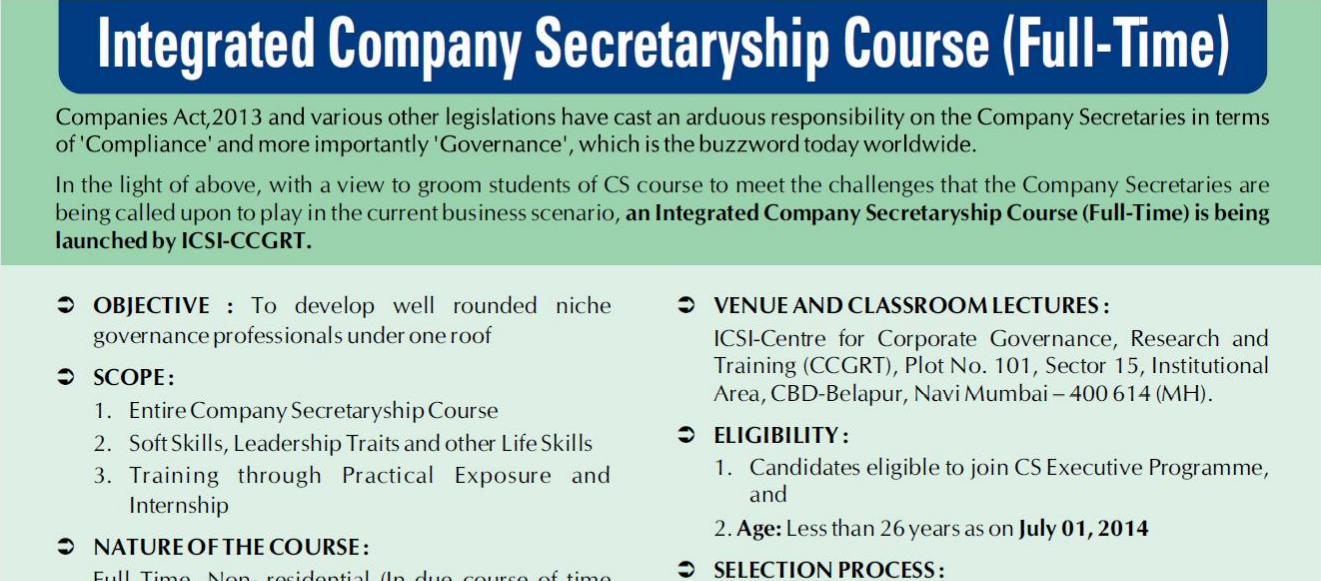
INTEGRATED COMPANY SECRETARYSHIP COURSE – FULL TIME


Full Time CS Course

The Institute of Company Secretaries of India has announces an integrated Company Secretaryship Course – Full Time on its web – site Recently. Readers may find details at the following link:

https://www.icsi.edu/portals/0/INTEGRATED_COMPANY_SECRETARYSHIP_COURSE_FULL_TIME.pdf

1. What is this integrated Company secretaryship course – Full time?

2. Was any response invited from stakeholders particularly from members?

3. Is it meant to create a class of full time students against present part – time students?

4. What measure have been taken to ensure that Industry will take all company secretaries as equal irrespective of course chosen – Full time or part time?

5. Why is there only one year training period there for these students against two years for general part time students? Is not it meant creating a separate class among students itself? 

Readers may leave comments in the Comment section here under.

REGISTERS AND ANNUAL RETURN


In last post, we discussed about register of members, register of debenture – holders and register of other security holders. Now, we will discuss, some other provisions related to these registers and also about annual return.

PLACE OF KEEPING AND INSPECTION OF REGISTERS AND RETURNS (SECTION 94):

The registers required to be kept and maintained by a company under section 88 and copies of the annual return filed under section 92 shall be kept at the registered office of the company.

Continue reading

PROSPECTUS (Companies Act 2013)


In last post, public offer and private placement we have discussed public offer. In this post we will discuss Prospectus under Companies Act, 2013

Clause (70) of Section 2 of this Bill define “prospectus” means any document described or issued as a prospectus and includes a red herring prospectus referred to in section 32 or shelf prospectus referred to in section 31 or any notice, circular, advertisement or other document inviting offers from the public for the subscription or purchase of any securities of a body corporate.

Section 26 deals with matters to be stated in prospectus.

Continue reading

APPOINTMENT AND QUALIFICATION OF DIRECTOR


UPDATE: on 30th August 2013: Companies Bill 2012 became the Companies Act, 2013 (Act 18 of 2013).

I discussed in my last post that it is first time that concept of “Key Managerial Personnel” has been introduced in India. Hopefully, present Companies Bill will change status of Corporate Governance in India. The qualified Directors and transparency in appointment of directors is single most important key for success of public corporate and corporate governance. As I discussed, appointment of “Key Managerial Personnel” is discussed in Section 203 but specific provisions of Chapter XI should be taken care of in case of appointment of Directors as they are specific provisions for them. Chapter XI consists of 23 Section from Section 149 to Section 172.

Continue reading

KEY MANAGERIAL PERSONNEL


UPDATE: on 30th August 2013: Companies Bill 2012 became the Companies Act, 2013 (Act 18 of 2013).

In any jurisdiction, Quality of Corporate Governance and compliance of ethics depends upon quality of people taking charge of the affairs. The companies Bill 2012 have some inbuilt elements of corporate governance in it. First time Concept of Key Managerial Personnel is being introduced in India. Which seems different with “officer who is in default” as that concept is still in this Bill.

Continue reading

FOOTSTEPS OF CORPORATE GOVERNANCE IN COMPANIES ACT 2013


(UPDATE: on 30th August 2013: Companies Bill became the Companies Act, 2013 (Act 18 of 2013). Post updated accordingly)

In my blog post titled “Corporate Governance: Regulatory Frameworks under Consideration” I mentioned that some of the provisions related to corporate governance and voluntary guideline on corporate governance issued by Ministry of Corporate Governance has been incorporated into new Companies Bill, 2012 [now, the Companies Act, 2013]. In this post, I will examine these provisions and their effect on corporate governance.

Continue reading

Introducing: AishMGhrana Governance Professional


The Institute of Company Secretaries of India has its Continuing willingness to present itself as a world leader as professional body of Corporate Governance professionals. This is a welcome transformation of Company Secretary from a mere clerk to Corporate Governance professional. The ICSI said as a member of CSIA it will ask the World Trade Organization (WTO) to include corporate governance and related areas in its mode of business classification.

Continue reading

CORPORATE DIPLOMACY


International relation not only affect governments but public at large. In globalised world, international relations have been reached to our neighborhood tea stall or grocery shop. We judge a nation by product, we buy. We may not know, where Finland is in world map, but we know Nokia in our hand. We will surely judge Finland by Nokia. This is a public diplomacy.

The ever expanding flow of commercial products and services across borders has important implications for public diplomacy. Despite the escalation of transnational corporations, high profile brand names are closely connected with their countries of origin. Coca Cola, Nike and McDonald’s are inextricably tied with the United States. The same associations are true for Ikea with Scandanavia, Nokia with Finland, Sony with Japan, and Nestle with Switzerland.[i]

Continue reading

FLAWS IN FORM 32: WITH RESPECT TO APPOINTMENT OF A COMPANY SECRETARY


Present scheme of the Companies Act, 1956 treat wrong doing principal officers of a company as “officer who is in default”. The Act under Section 5 explicitly lists “Officer who is in default”. This list, which looks like a most wanted list of police department, really cast numerous responsibilities on these officers. Presently, the Secretary of the company seems to be only professional listed herein. As all other persons, may or may not be professionally qualified, are business person and technical persons with only average person knowledge of his legal responsibilities. This section not only cast on the secretary practically all legal responsibilities of the company’s legal administration but also put him in much bigger shoes.

Continue reading