Category Archives: Governance and Responsibility

Governance and Responsibility – In life of Nation, State, Government, Corporate, Society and Individual

EASE IN TAXATION


Very Soon, Indian Finance Minister will finalize this tax proposal keeping (possible a blind) eye on tax reforms. Indirect tax reforms, even at the central side of constitutional barriers are still at halt just because of long time of eye – wash of Goods and Service Tax reform There is no concrete information on present status and future of Direct Tax Code. We as citizen need to understand and reveal hardship of our tax system and support a simpler tax regime. Our views may help the Government.

Continue reading

COMMON OBLIGATIONS OF LISTED ENTITIES -2


Chapter III of the Securities and Exchange Board of India (Listing Obligation and Disclosure Requirements) Regulations, 2015 enumerates common obligations of listed entities. In this post, we will discuss some of these obligations related to Intermediaries, filings, grievance redressal mechanism Continue reading

National Herald and the Companies Act, 2013


National Herald was a newspaper and is a building and, for most political activist on social media, a case by a politician against its rivals.

Continue reading

COMMON OBLIGATIONS OF LISTED ENTITIES -1


Chapter III of the Securities and Exchange Board of India (Listing Obligation and Disclosure Requirements) Regulations, 2015 enumerates common obligations of listed entities. In this post, we will discuss some of these obligations related to Key Managerial Personnel, Compliance officer and Share Transfer Agent.

Continue reading

GOVERNANCE PRINCIPLES GOVERNING DISCLOSURES AND OBLIGATIONS


Regulation 4 of the Securities and Exchange Board of India (Listing Obligations and Disclosure Requirements) Regulations 2015 enumerates principles governing disclosure and obligations of listed entities. There are two different set of principles one is general and second governance principles. In this post, we will discuss, governance principles.

Corporate Governance Principle

The listed entity which has listed its specified securities shall comply with the corporate governance provisions as specified in chapter IV which shall be implemented in a manner so as to achieve the objectives of the principles mentioned in Regulation 4(2) of SEBI (LODR) Regulations 2015.

Continue reading

MGT – 7 (v. 17Nov2015)


We live in a changing world; corporate world changing fast and Indian Corporate Law fastest. A draft of the Companies (Management and Administration) third Amendment Rules, 2015 dated 16th November 2015, which is pending for publication in Official Gazette of India amend the version of form MGT -7 once again. Though these amendment rules are not available in official gazette, new version of form MGT – 7 is made available on the MCA21 portal for filing.

Note: MGT – 7 Version 17th November 2015 is being used for writing this post. Earlier posts here and here are only historic relevance now.

Continue reading

GENERAL PRINCIPLES GOVERNING DISCLOSURES AND OBLIGATIONS


Regulation 4 of the Securities and Exchange Board of India (Listing Obligations and Disclosure Requirements) Regulations 2015 enumerates principles governing disclosure and obligations of listed entities. There are two different set of principles one is general and second governance principle. In this post we will discuss general principles which deal with accounting standards, misrepresentation, adequate and timely disclosure, applicable laws and specified disclosures.

Continue reading

RELATED PARTY TRANSACTIONS


The Securities and Exchange Board of India (Listing Obligation and Disclosure Requirements) Regulations 2015 was notified on 2nd September 2015 and will come into force from 1st December 2015. However, Regulation 31A of the SEBI (Listing Obligation and Disclosure Requirements) Regulations, 2015 came into force on 2nd September 2015 on publication of these regulations along with sub – regulation (4) of Regulation 23. In last post here, we discussed Regulation 31A and in this post we will discuss Regulation 23.

Continue reading

Class of shareholders


The Securities and Exchange Board of India (Listing Obligation and Disclosure Requirements) Regulations 2015 was notified on 2nd September 2015 and will come into force from 1st December 2015. However, Regulation 31A of the SEBI (Listing Obligation and Disclosure Requirements) Regulations, 2015 came into force on 2nd September 2015 on publication of these regulations along with sub – regulation (4) of Regulation 23. Regulation 31A deals with Disclosure of Class of shareholders and Conditions for Reclassification.

Continue reading

RELATED PARTY


The Securities and Exchange Board of India (Listing Obligation and Disclosure Requirements) Regulations 2015 was notified on 2nd September 2015 and will come into force from 1st December 2015. In this post we will discussion definition of Holding, Subsidiary, Associates, Relative, Related Party, and Related Party Transactions.

Continue reading

Stock Exchanges and Listed Entities


The Securities and Exchange Board of India (Listing Obligation and Disclosure Requirements) Regulations 2015 was notified on 2nd September 2015 and will come into force from 1st December 2015. In this post we will discussion definition of Stock Exchanges, Listed Entities and other related terms.

Continue reading

City in Companies Act, 2013


Companies Act, 2013 uses city 3 times (without taking subordinate legislations into account):

  • In section 12(5)(a) with reference to registered office;
  • In Section 27(1) for advertisement in news paper in the city of registered office;
  • In Section 96(2) for place of Annual General Meeting in city of registered office.

The Companies Act, 1956 also used this term in similar reference.

Continue reading

Designated Securities


The Securities and Exchange Board of India (Listing Obligation and Disclosure Requirements) Regulations 2015 was notified on 2nd September 2015 and will come into force from 1st December 2015. In this post we will discussion definition of Designated Securities.

Continue reading

Promoter and Promoter Group


The Securities and Exchange Board of India (Listing Obligation and Disclosure Requirements) Regulations 2015 was notified on 2nd September 2015 and will come into force from 1st December 2015. In this post we will discussion definitions of promoter and promoter group in these regulations.

Continue reading

Listing obligation and Disclosure Regulation


Presently, a private agreement between Stock Exchange and listed company govern all listing obligation and disclosure requirement. This listing agreement like any other agreement among parties creates civil obligation in case of any violation of the agreement.

Continue reading

That Audit Report


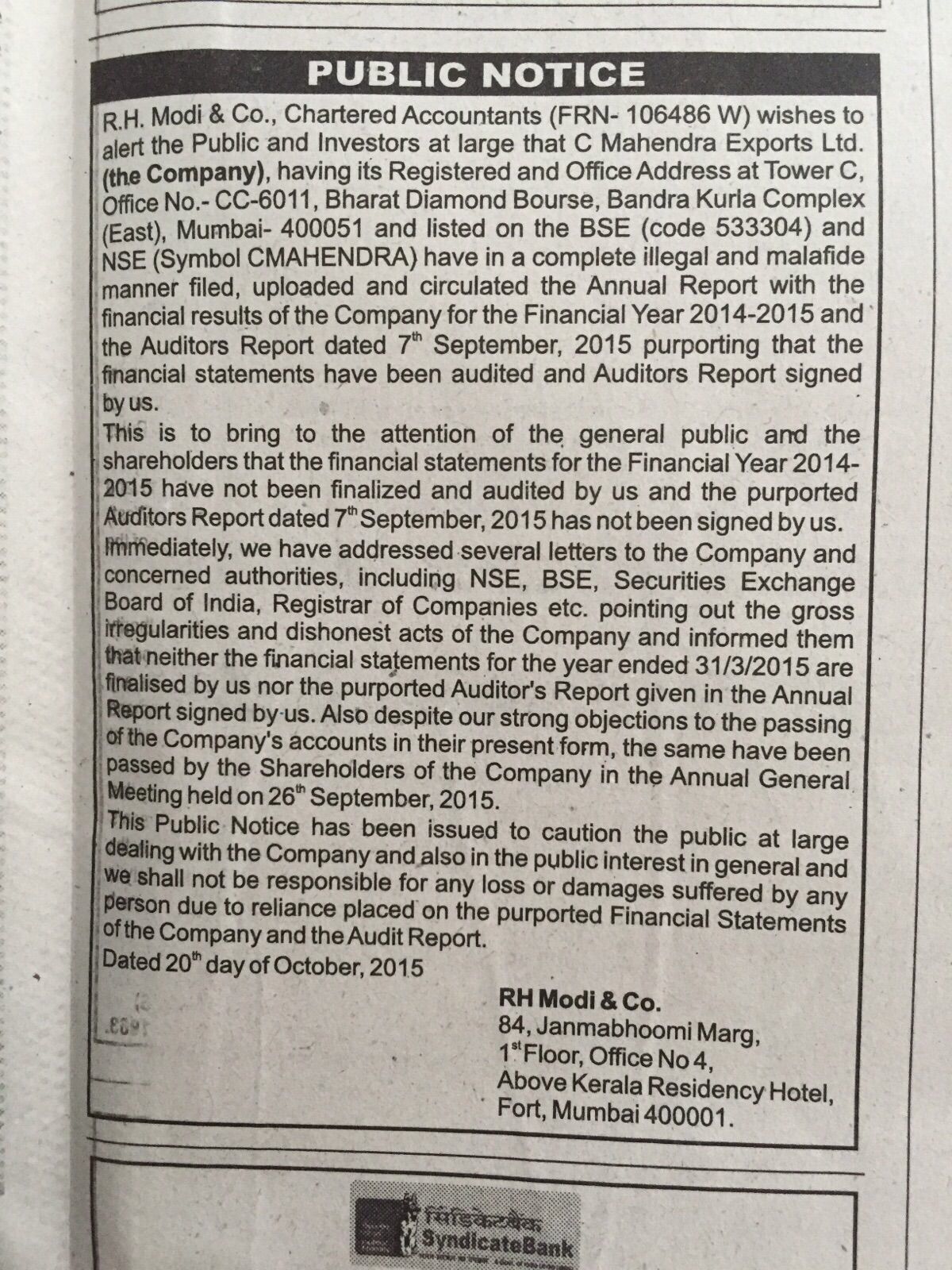
Indian corporate world was shocked and corporate governance became a question when on 20th October 2014, M/s. R. H. Modi  & Co., Chartered

Public Notice by Auditors

Public Notice by Auditors

Accountants, auditor of C. Mahendra Exports Limited published a public notice in newspaper. It was alleged that the company “in a complete illegal and malafide manner filed, uploaded and circulated the Annual Report with the financial results of the company for financial year 2014 – 15 and the auditor report dated 7th September 2015 purported that the financial statements have been audited and Auditors Report signed by us (M/s. R. H. Modi  & Co., Chartered Accountants).

The auditor in this public notice claimed that these financial statements have not been finalised and audited by them. The auditor claimed that despite their strong objection to the passing of company’s account in their present form, the same have been passed by the shareholders of the company in annual general meeting held on 26th September 2015.

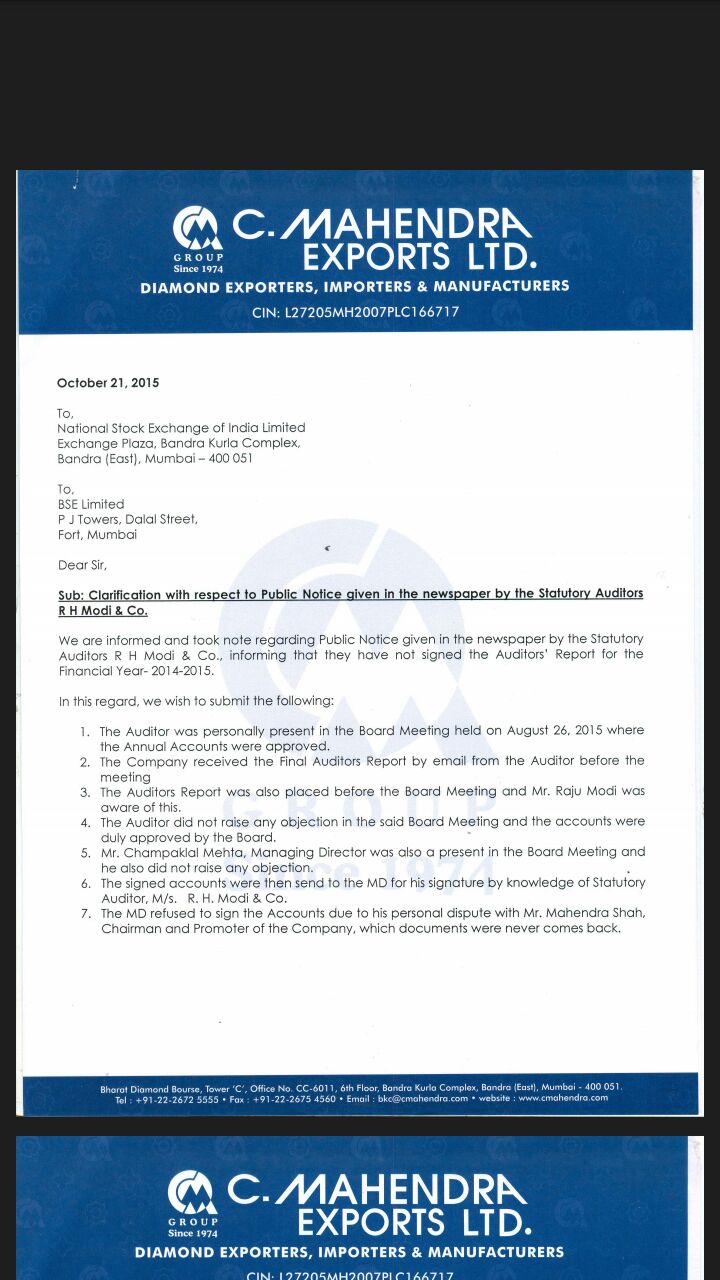
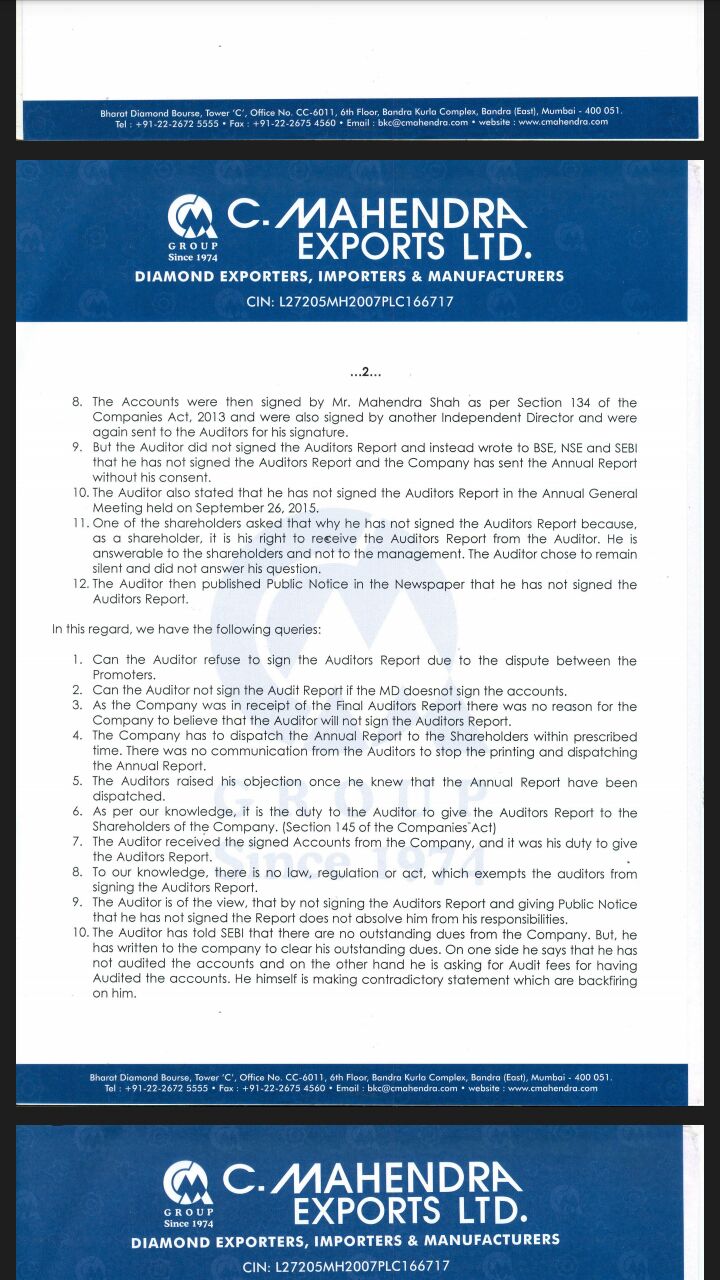
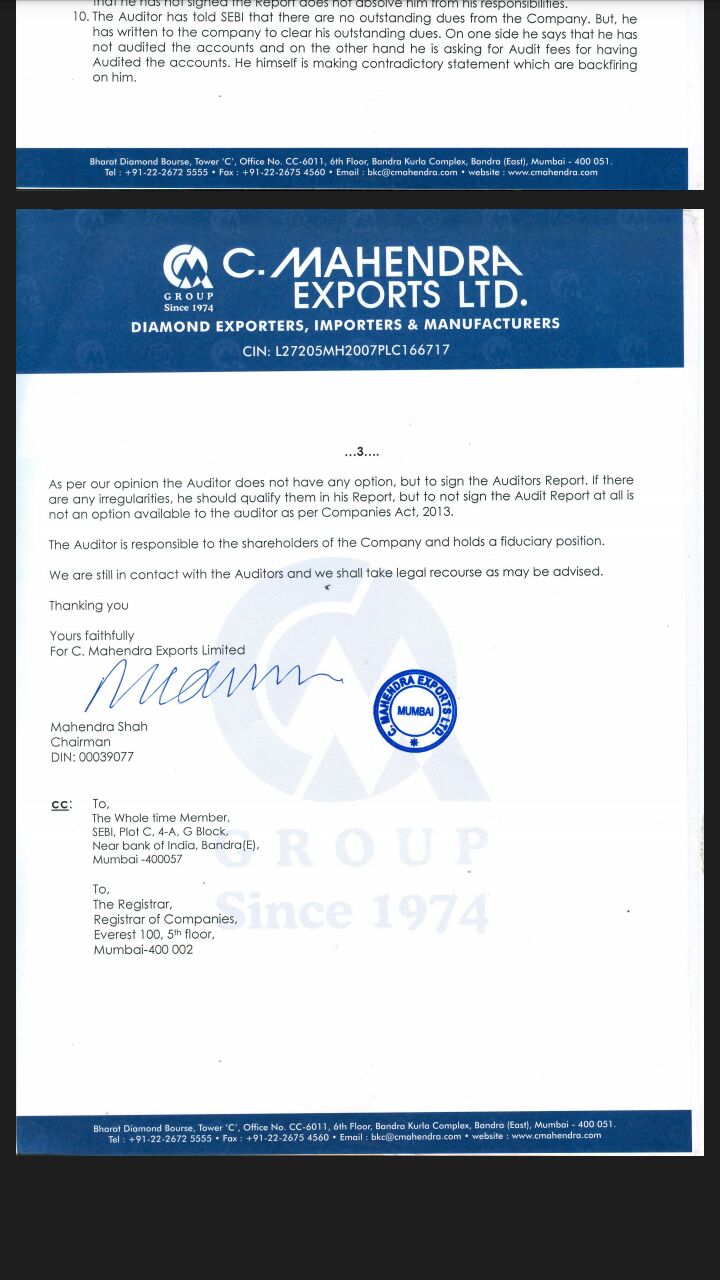
The company filed its clarification before stock exchanges, which is available in site of Bombay Stock Exchange here and site of National Stock Exchange here. The company not only stated facts from their side but also raised several questions on point of law.

According to facts mentioned by the company, Managing Director and Statutory Auditors did not sign the financial statements and Auditors Report. The company presented following interesting queries:

  1. Can the auditor refuse to sign the auditor’s report due to dispute between the promoters?
  2. Can the Auditor not sign the Audit Report if the MD does not sign the accounts?

Fully clarification written by the company is worth academic reading.

This blog does not want to discuss on the matter which may soon go to inquiry by relevant professional bodies and regulators. However, development on this matter may be of academic interests.

Reply by Company P.1

Reply by Company P.1

Reply by Company P.2

Reply by Company P.2

Reply by Company P.3

Reply by Company P.3

REPRESENTATIVE, PROXY AND WHO ELSE


This is not possible every time for a member to be present in a General Meeting. Members are very much concerned for well being of the company, its management, profit and growth. Corporate law does not permit members to participate members to interfere in day to day management. A member at most may seek certain information or participate in general meetings of the company. Participation in a meeting need a presence; a personal presence of a member. Even in a virtual presence, a member needs to spare time for the purpose.

Representative:

Further, it may also be possible that member is a corporate sole like President of India or Governor of an Indian State who may not be present himself but through representative. President of India and Governor of an Indian State may appoint a person as his representative for a meeting of the company [Section 112(1)]. Where a member is a body corporate, it may also appoint a person as representative [Section 113(1)]

A representative of President or Governor shall be deemed to be a member of such a company and shall be entitled to exercise the same rights and powers, including the right to vote by proxy and postal ballot, as the President or, as the case may be, the Governor could exercise as a member of the company. [Section 112(2)]

A representative of body corporate shall be entitled to exercise the same rights and powers, including the right to vote by proxy and by postal ballot, on behalf of the body corporate which he represents as that body could exercise if it were an individual member, creditor or holder of debentures of the company. [Section 113(2)]

Major difference among representative under Section 112(2) and 113(3) is that representative of President or Governor shall be deemed to be a member but representative of body corporate is a mere representative who may exercise powers as a member. This difference arises from drafting and may not have much practical impact.

 Major similarity among representative under Section 112(2) and 113(3) is that both representatives may vote by proxy and postal ballot.

So now, for the purpose of this post, we may treat all members as individual as corporate sole and body corporate also being represented by individuals exercise same powers in the general meeting.

Proxy:

Where a member may not present, member may appoint a proxy under Section 105 of the Companies Act, 2013 t attend and vote in the meeting. Similar provision was there in earlier Acts also.

A proxy may vote even if member present personally in the meeting until members expressly revoke proxy or vote himself which implicitly revoke the proxy. [Tata Iron & Steel Co. Ltd., In Re., AIR 1928 Bom. 80].

We have discussed legal provisions related to proxies earlier here and here. We here reproduced only few provisions required for this post.

The instrument appointing a proxy shall be in writing and be signed by the appointer or his attorney. Where appointer is a body corporate, it shall be sealed of body corporate and signed by an officer of attorney. [Section 105(6)] The appointment of proxy shall be in the Form MGT – 11. [Rule 19(3)]

Limitation of Proxy:

Proxy is an agent for the purpose of voting on poll in a general meeting and cannot speak or vote otherwise. [Section 105(1)] What is use of such agent, if the voice of the member could not reach and heard in General Meeting? This limit right of the members to certain manner.

This limited right to appoint is not available to all classes of members. A member of a company not having a share capital shall not be entitled to appoint proxy unless articles provide so. Central Government may also specify companies whose members shall not be entitle to appoint a proxy.  [Proviso to Section 105(1)]

How can a member ensure to coup with such limitation where he could not be represented through proxy? How can a member ensure his voice in general meeting?

Attorney:

The companies Act, 2013 does not give the answer to abovementioned questions. This does not render a member helpless. The Power of Attorney Act, 1882 come to rescue a member in this situation.

A Power of Attorney includes any instrument empowering a specified person to act for and in the name of the person executing it. [Section 1A of the Power of Attorney Act, 1882]

A ‘power-of-attorney’ means a formal instrument by which one person empowers another to represent him, or act in his stead, for certain purposes, usually in the form of a deed poll, and attested by two witnesses. The donor of the power is called the principal or constituent; the donee is called the attorney or agent. [Osborn’s Concise Law Dictionary, 7th Edn.,]

The donee of a power of attorney may execute pr do any instrument or thing in and with his own name and signature, and his own seal, where sealing is required, by authority of the donor of the power; and every instrument and thing so executed and done, shall be as effectual in law as if it had been executed or done by the donee of the power in the name, and with the signature and seal, of the donor thereof. [Section 2 of the Power of Attorney Act, 1882]

However, an attorney may do such act only when the attorney and the donor have capacity to make contract.

Where a Power of Attorney contains the following words “… to appear and to represent me at any meeting of any joint stock company in which I am interested as a shareholder or debenture holder or preference shareholder, or as a member or otherwise and to vote there, and also to grant proxies to any other person …” These words are sufficient for attorney to exercise powers of member in a general meeting. [Tata Iron & Steel Co. Ltd., In Re., AIR 1928 Bom. 80].

A holder of General Power of Attorney shall be treated as member personally present not as a proxy. Accordingly, he will be counted for the purpose of quorum. A General Power of Attorney may include all power of members which it may exercise as members under the Companies Act 2013 and any other law for the time being in force.

However, a power of attorney executed outside India shall be treated in accordance with the law of that that country for the time being in force.

Please note: This blog invite readers to share their comments, suggestions, hardship, queries and everything in comment section. This blog post is not a professional advice but just a knowledge sharing initiative for mutual discussion.

AOC – 4 XBRL (v. 1st October2015)


MCA recently introduced the Companies (Filing of Documents and forms in XBRL) Rules 2015 dated 9th September 2015 for which I have yet to locate published copy in the Official Gazette. These rules shall come into force from the date of publication in Official Gazette. These rules have already discussed earlier here.

Note: AOC – 4 XBRL Version 1st October 2015 is being used for writing this post.

Continue reading

Counter Puzzle of Auditor Appointment


No doubt the Companies Act, 2013 is not a law but collection of legal puzzle. Compliance of its provisions became hell. This is not just because of poor drafting of law but poor reading of law. We student of the Companies Act, 2013 need to unlearn the Companies Act, 1956 first and finally. We need to know, learn, understand and educate ourselves that the Companies Act, 1956 is now only for reference purpose only.

In last post, we discussed puzzle of ADT – 1 here but every coin have second side also. In that post we start reading form the charging sub – section and in this post we will start reading form the compliance required by the Ministry i.e. ADT – 1 itself.

Continue reading

Puzzle of Auditor Appointment (ADT – 1)


No doubt the Companies Act, 2013 is not a law but collection of legal puzzle. Compliance of its provisions became hell. This is not just because of poor drafting of law but poor reading of law. We student of the Companies Act, 2013 need to unlearn the Companies Act, 1956 first and finally. We need to know, learn, understand and educate ourselves that the Companies Act, 1956 is now only for reference purpose only.

In this post we will try to solve puzzle of ADT – 1, Rule 4 and Section 139.

Continue reading