Category Archives: CorpGov

Aside

I have done a survey earlier on working of MCA21 and wrote a post based on that survey. You can find that post here. Based on these result, I have an RTI reply discussed here. Now, I am here with … Continue reading

EXERCISE OF POWER IN BOARD MEETING


One simple solution for cost effective and efficient method to pass a resolution is by passing it by circulation. Section 175 of the Companies Act 2014 the resolution shall be circulated in draft together with all necessary papers to all directors (or members of committee) in same manner as notice. The resolution shall be passed when approved by majority of directors (or members) who is entitled to vote. When one third or more directors require that it must be decided in a meeting, it shall be decided in meeting. Every resolution passed by circulation must be noted in next board meeting and made part of minutes of that meeting. Rule 5 of these Rules adds, a resolution in draft form may be circulated to the directors together with the necessary papers for seeking their approval, by electronic means which may include E-mail or fax.
Continue reading

COMMITTEES AND VIGIL MECHANISM


We have discussed Committees under the Companies Act 2013 earlier here.

Following committees has statutory mandate:

  1. Social Responsibility Committee
  2. Audit Committee
  3. Nomination and Remuneration Committee, and
  4. Stakeholders Relationship Committee.

The requirement related to Social Responsibility committees is given in Section 135 and the Companies (Corporate Social Responsibility Policy) Rules 2014. Section 178(5) requires every company with more than one thousand shareholders to have stakeholders’ relationship committee. Rule 6 of the Companies (Meeting of Boards and its powers) Rules 2014 set threshold limits.  The Board of directors of every listed company and the following classes of companies shall constitute an Audit Committee and a Nomination and Remuneration Committee of the Board-

Continue reading

MEETING THROUGH AUDIO VISUAL MEANS


According to Section 173(2) of the Companies Act 2013, directors may participate through:

  1. In person,
  2. Through Video Conferencing,
  3. Other Audio – visual means, as may be prescribe.

Such means must be capable of recording of proceedings and recognising the participation of directors.

The Companies (Meetings of Boards and its Powers) Rules 2014 elaborate provisions related to meeting through audio visual means.

Continue reading

COMPENSATION TO DIRECTOR FOR LOSS OF OFFICE


Section 191 of the Companies Act 2013 discusses payment of compensation for Director for loss of office.  In an earlier post here, we have discussed this section in detail.

According to sub – section (1) of section 191, no director of a company shall, in connection with—

Continue reading

REMUNERATION OF DIRECTORS


We have already discussed remuneration of managerial personnel under Section 197 read with Schedule V of the Companies Act 2013. In addition to managerial remuneration under Section 197 a company may pay sitting fees to its directors.

According to Rule 4 of the Companies (appointment and Remuneration of Managerial Personnel) Rule 2014, a company may pay a sitting fee to a director for attending meetings of the Board or committees thereof, such sum as may be decided by the Board of directors thereof which shall not exceed one lakh rupees per meeting of the Board or committee thereof. For Independent Directors and Women Directors, the sitting fee shall not be less than the sitting fee payable to other directors.

Continue reading

APPOINTMENT OF MANAGERIAL PERSONNEL


Section 196 of the companies Act 2013 deals with appointment of certain managerial personnel namely; Managing Director, Whole time Director and Manager. Remuneration of these managerial personnel is discussed in Section 197 read with Schedule V of the Companies Act 2013. Section 203 of this Act further deals with appointment of certain other managerial personnel along with managerial personnel already discussed in Section 197.

According to Rule 3 of the Companies (appointment and Remuneration of Managerial Personnel) Rule, 2014, A company shall file a return of appointment of a Managing Director, Whole Time Director or Manager, Chief Executive Officer (CEO), Company Secretary and Chief Financial Officer (CFO) within sixty days of the appointment, with the Registrar in Form MR – 1 along with such fee as may be specified for this purpose. We have earlier discussed Form MR – 1 in detail here.

Continue reading

RESIGNATION OF A DIRECTOR


According to Section 168 of the Companies Act 2013 A director may resign from his office by giving a notice in writing to the company and the Board shall on receipt of such notice take note of the same and the company shall intimate the Registrar in such manner, within such time and in such form as may be prescribed and shall also place the fact of such resignation in the report of directors laid in the immediately following general meeting by the company. A director shall also forward a copy of his resignation along with detailed reasons for the resignation to the Registrar within thirty days of resignation in such manner as may be prescribed.

Rule 16 of the Companies (Appointment and Qualification of Directors) Rules 2014 prescribed that where a director resigns from his office, he shall within a period of thirty days from the date of resignation, forward to the Registrar a copy of his resignation along with reasons for the resignation in Form DIR – 11 along with the fee as provided in the Companies (Registration Offices and Fees) Rules, 2014.

Continue reading

APPOINTMENT OF DIRECTOR


Appointment of directors for this blog post does not include re – appointment of directors as such. But surely provisions are different only on compliance with Section 160 of the Companies Act 2013.

When an appointment of a director is proposed, the process starts with Notice of candidature under Section 160.

A person who is not a retiring director in terms of section 152 shall, subject to the provisions of this Act, be eligible for appointment to the office of a director at any general meeting, if he, or some member intending to propose him as a director, has, not less than fourteen days before the meeting, left at the registered office of the company, a notice in writing under his hand signifying his candidature as a director or, as the case may be, the intention of such member to propose him as a candidate for that office, along with the deposit of one lakh rupees or such higher amount as may be prescribed which shall be refunded to such person or, as the case may be, to the member, if the person proposed gets elected as a director or gets more than twenty-five percent of total valid votes cast either on show of hands or on poll on such resolution. The company shall inform its members of the candidature of a person for the office of director under sub-section (1) in such manner as may be prescribed.

Further procedure related to the notice is explained under Rule 13 of the Companies (Appointment and Qualification of Directors) Rules 2014.

Continue reading

SMALL SHAREHOLDERS DIRECTORS


A listed company may have one director elected by such small shareholders in such manner and with such terms and conditions as may be prescribed. [Section 151]

“Small shareholders” means a shareholder holding shares of nominal value of not more than twenty thousand rupees or such other sum as may be prescribed.

Rule 7 of the companies (Appointment and Qualification of Directors) Rules 2014

Continue reading

INDEPENDENT DIRECTOR


According to Section 149 of the Act, every listed company shall have at least one-third of total number of directors as Independent directors. The central government may prescribe minimum number of independent directors in other class or classes of public companies. The Act deals with provisions related to independent directors in details as discussed earlier here.

According to Rule 4 companies (Appointment and Qualification of Directors) Rules 2014, the following class or classes of companies shall have at least two directors as independent directors –

Continue reading

WOMAN DIRECTOR


The Companies Act 2013 has gone miles towards its social justice objectives. This includes woman director, independent director and small shareholders directors. We have all these provisions in the Act earlier here. The companies (Appointment and Qualification of Directors) Rules 2014 further elaborate these provisions.

Women Director:

Rule 3 of the companies (Appointment and Qualification of Directors) Rules 2014 elaborate the provision of second proviso of sub – section (1) of Section 149 of the Act. The following class of companies shall appoint at least one woman director –

Continue reading

DISQUALIFICATION OF DIRECTORS


Section 164 of the Companies Act 2013, as discussed earlier here; deal with Disqualification for appointment of directors. Sub – section (1) of Section 164 list disqualifications of directors for appointment as a director of a company. The Appointment shall include reappointment but not continuation to be in office. Disqualification in this sub – section is general in nature and shall apply for an appointment and reappointment of such director in a company.

Sub – section (2) of Section 164 adds two disqualifications which are applicable to reappointment of director in same company and appointment in any other company for a period of five years from the date on which the said company defaulted and disqualification arises.

Continue reading

MULTIPLE DIRECTOR IDENTIFICATION NUMBERS


Recently, Subramanian Swamy had filed complaint against Priyanka Vadra for possessing multiple DINs. Subramanian Swamy had also complained against Karti Chidambaram. This put social media on storm during elections but storm is not over with elections. Daily, social media teams of all parties unearth some new names with multiple DINs.

After new government sworn in centre, name of many ministers is open over twitter. This was discussed over social media that Nitin Gadkari has six DINs as well. Piyush Goyal who himself is a Chartered Accountant, has two DINs.

Continue reading

DECLARATION AND PAYMENT OF DIVIDEND


In an earlier post here, we have discussed provisions related to dividend under the Companies Act, 2013. Now we have the Companies (Declaration and Payment of Dividend) Rules 2014 as notified on 31st March 2014 for discussion.

Continue reading

ISSUING GLOBAL DEPOSITORY RECEIPTS


Section 41 of the Companies Act, 2013 is simply interesting provision which leave everything for legislative capacity of executives. We have discussed this provision earlier here.

Under wide powers, the Ministry framed the Companies (issue of Global Depository) Rules 2014.

Continue reading

Representation before Stakeholders on Companies Rules 2014


Dear Stakeholders of Corporate India,

As a most vibrant corporate community of the world, you are aware or recent unwelcome development related to corporate India like Satyam, Sahara and Saradha. These developments raised strong concern among us and Parliament of India as well. This reflects in core principles of the Companies Act, 2013. India has some of the best corporate governance and social responsibility norms in the world.

Continue reading

Appeal of ICSI to its Members and Students


Institute of Company Secretaries of India has mailed an “appeal” to its members and student on 1st April 2014. This was not an April Fool Prank. This letter is in public domain and is a public document.

 In following paragraph, we will discuss this “appeal”:
Continue reading

LIMITING RISK OF LIABILITY


What is benefit of incorporating of a company? One of most important benefit of incorporation is limiting risk of liability.

In case of traditional form of businesses; proprietor, partnership or family businesses; there is no concept of limited liability. An owner or part – owner is responsible to pay all business debt even from its own pocket. We always know, business money (galla) is different from personal money. But, owner of a business remains in risk of liabilities towards creditors and government personally.

Continue reading

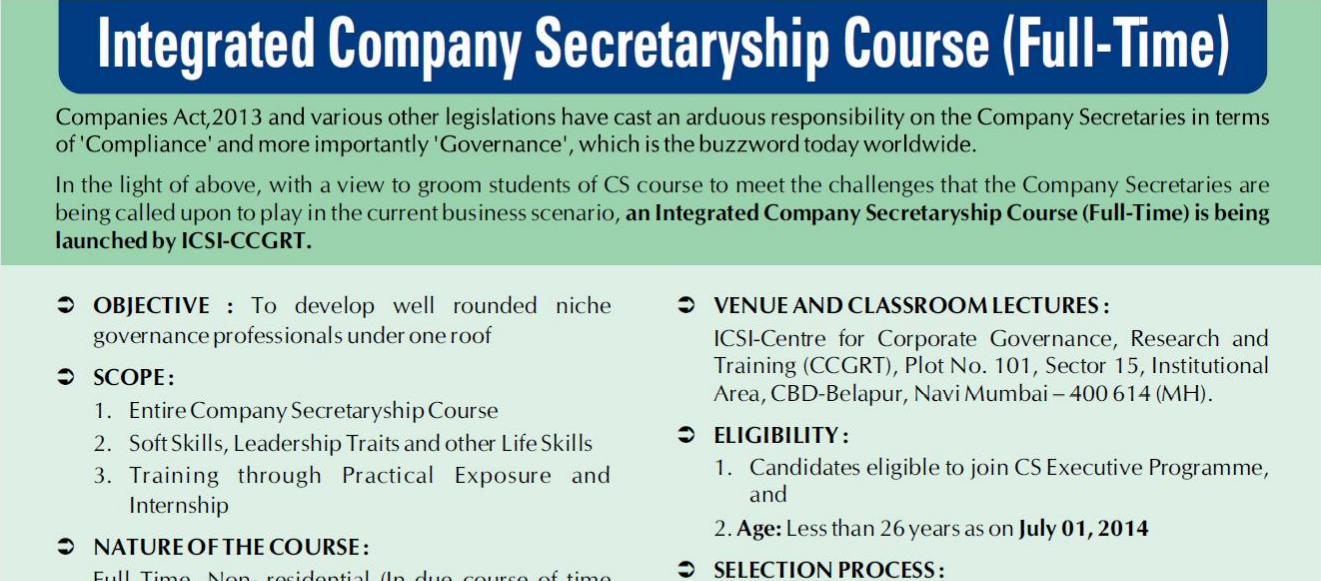
INTEGRATED COMPANY SECRETARYSHIP COURSE – FULL TIME


Full Time CS Course

The Institute of Company Secretaries of India has announces an integrated Company Secretaryship Course – Full Time on its web – site Recently. Readers may find details at the following link:

https://www.icsi.edu/portals/0/INTEGRATED_COMPANY_SECRETARYSHIP_COURSE_FULL_TIME.pdf

1. What is this integrated Company secretaryship course – Full time?

2. Was any response invited from stakeholders particularly from members?

3. Is it meant to create a class of full time students against present part – time students?

4. What measure have been taken to ensure that Industry will take all company secretaries as equal irrespective of course chosen – Full time or part time?

5. Why is there only one year training period there for these students against two years for general part time students? Is not it meant creating a separate class among students itself? 

Readers may leave comments in the Comment section here under.