Category Archives: CorpGov

Promoter and Promoter Group


The Securities and Exchange Board of India (Listing Obligation and Disclosure Requirements) Regulations 2015 was notified on 2nd September 2015 and will come into force from 1st December 2015. In this post we will discussion definitions of promoter and promoter group in these regulations.

Continue reading

Listing obligation and Disclosure Regulation


Presently, a private agreement between Stock Exchange and listed company govern all listing obligation and disclosure requirement. This listing agreement like any other agreement among parties creates civil obligation in case of any violation of the agreement.

Continue reading

That Audit Report


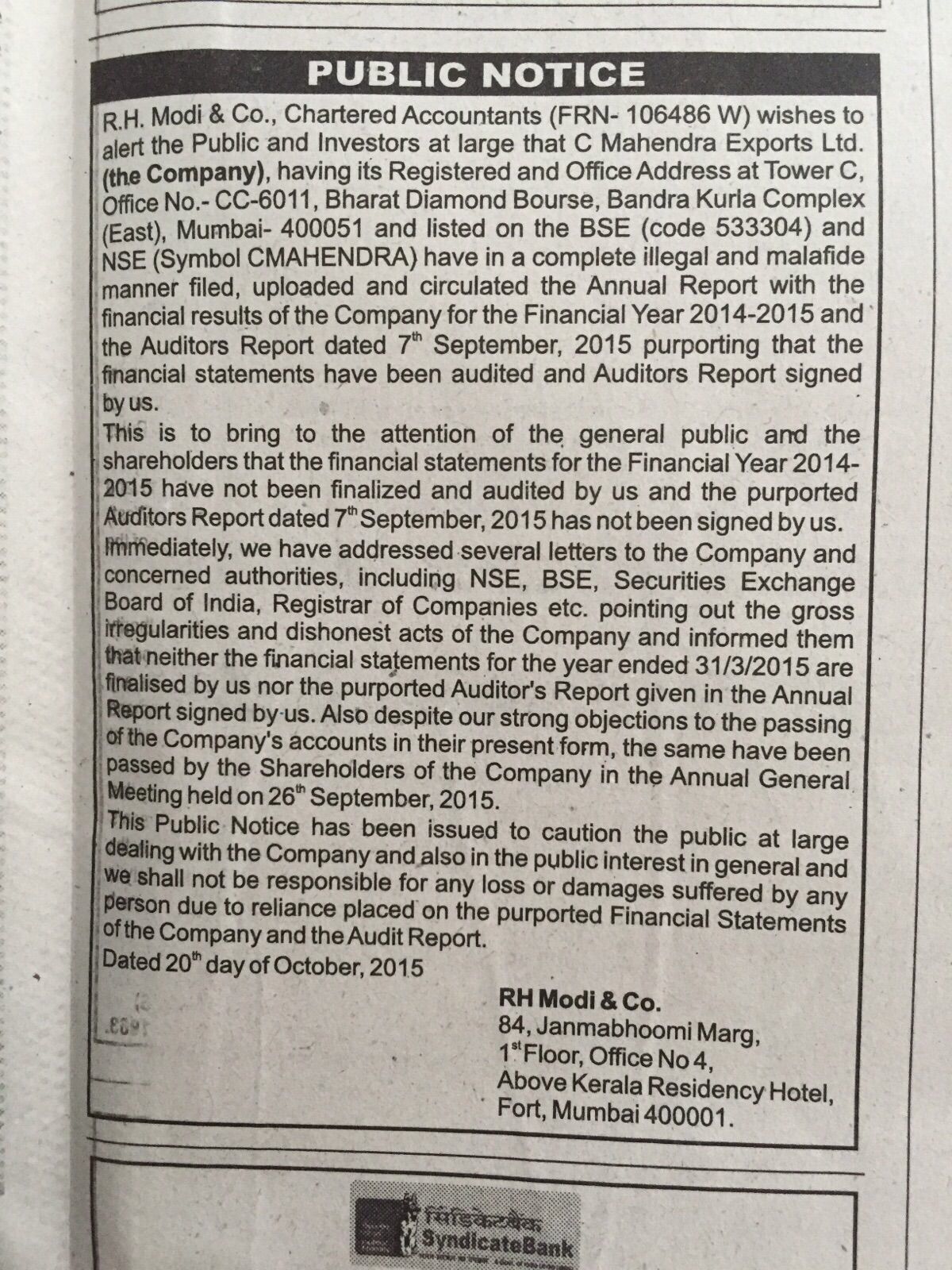
Indian corporate world was shocked and corporate governance became a question when on 20th October 2014, M/s. R. H. Modi  & Co., Chartered

Public Notice by Auditors

Public Notice by Auditors

Accountants, auditor of C. Mahendra Exports Limited published a public notice in newspaper. It was alleged that the company “in a complete illegal and malafide manner filed, uploaded and circulated the Annual Report with the financial results of the company for financial year 2014 – 15 and the auditor report dated 7th September 2015 purported that the financial statements have been audited and Auditors Report signed by us (M/s. R. H. Modi  & Co., Chartered Accountants).

The auditor in this public notice claimed that these financial statements have not been finalised and audited by them. The auditor claimed that despite their strong objection to the passing of company’s account in their present form, the same have been passed by the shareholders of the company in annual general meeting held on 26th September 2015.

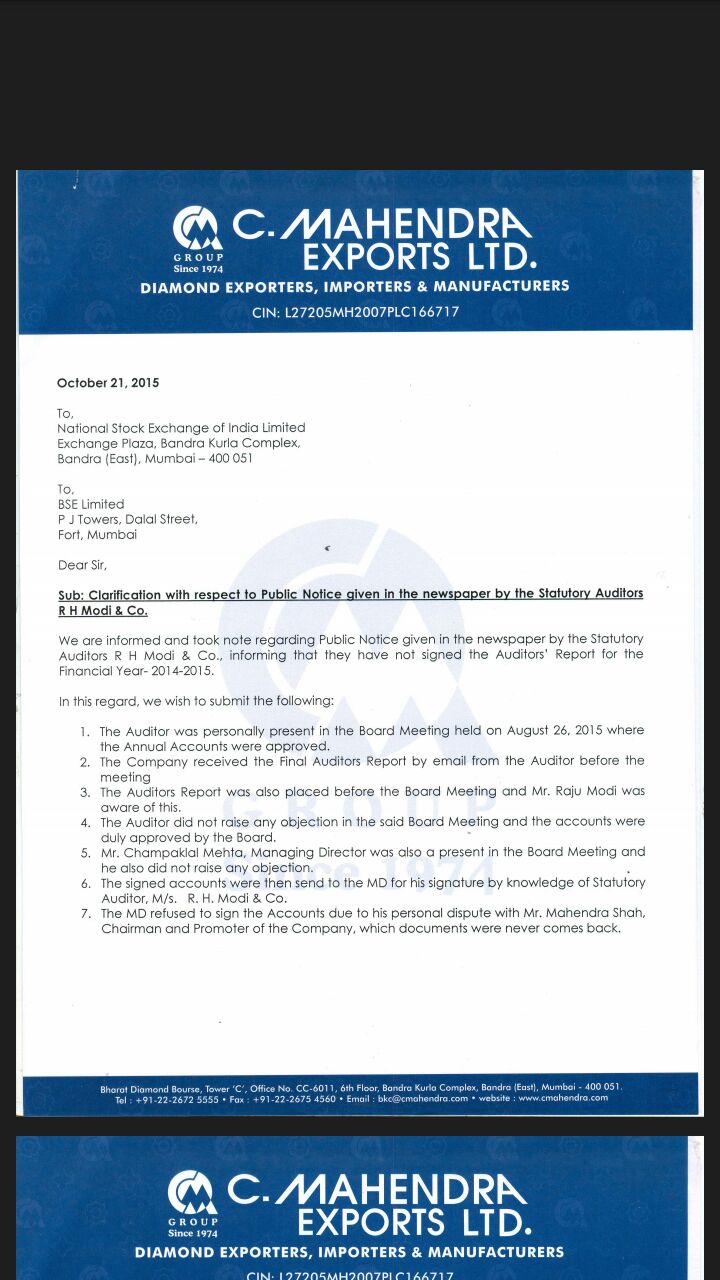
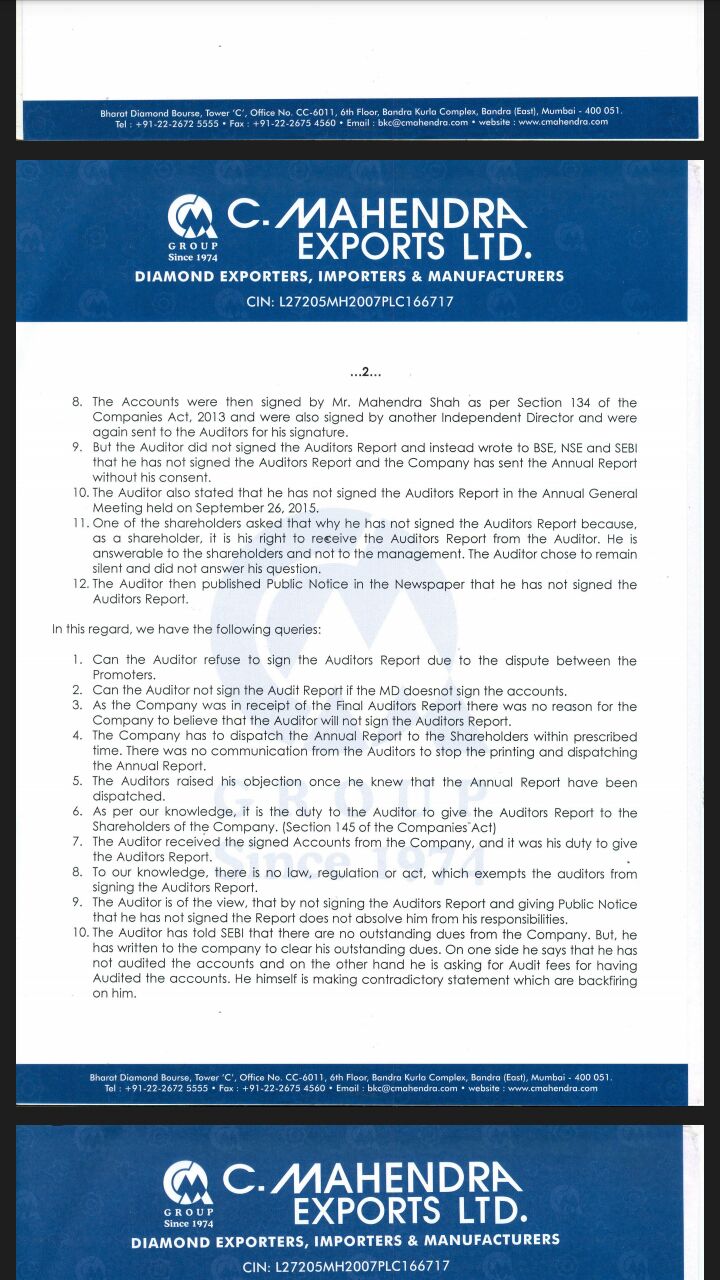
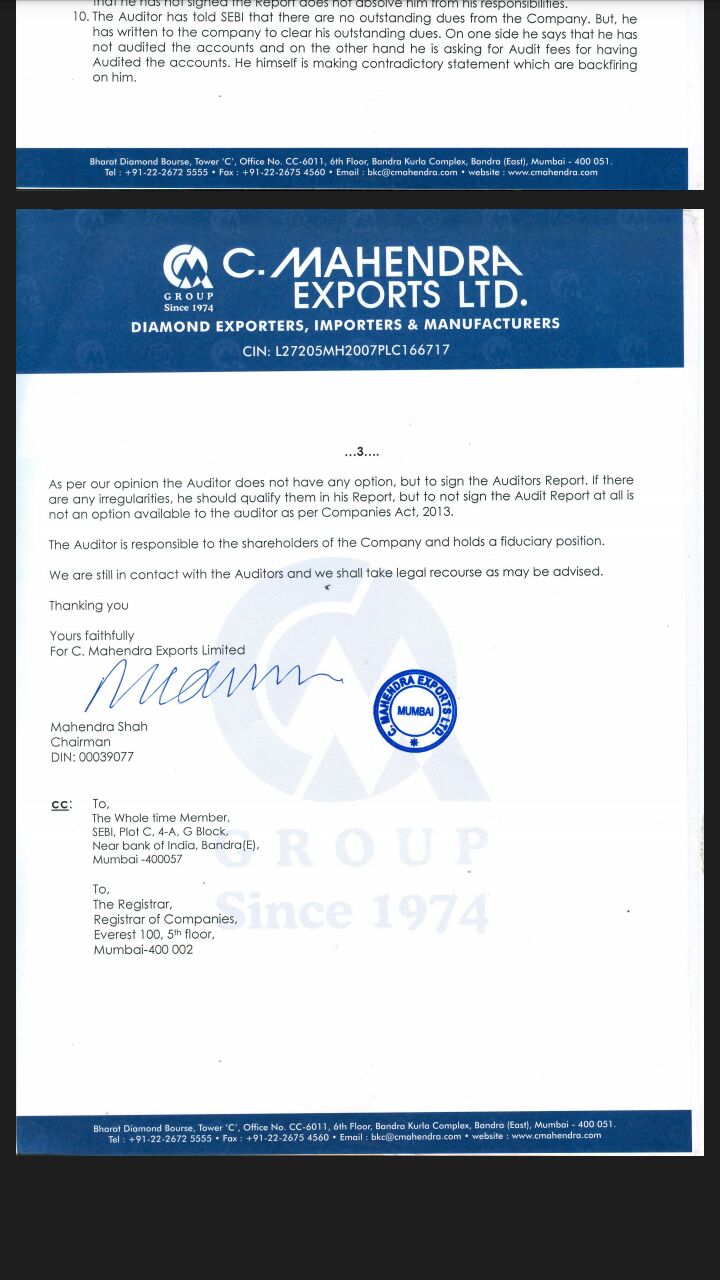
The company filed its clarification before stock exchanges, which is available in site of Bombay Stock Exchange here and site of National Stock Exchange here. The company not only stated facts from their side but also raised several questions on point of law.

According to facts mentioned by the company, Managing Director and Statutory Auditors did not sign the financial statements and Auditors Report. The company presented following interesting queries:

  1. Can the auditor refuse to sign the auditor’s report due to dispute between the promoters?
  2. Can the Auditor not sign the Audit Report if the MD does not sign the accounts?

Fully clarification written by the company is worth academic reading.

This blog does not want to discuss on the matter which may soon go to inquiry by relevant professional bodies and regulators. However, development on this matter may be of academic interests.

Reply by Company P.1

Reply by Company P.1

Reply by Company P.2

Reply by Company P.2

Reply by Company P.3

Reply by Company P.3

REPRESENTATIVE, PROXY AND WHO ELSE


This is not possible every time for a member to be present in a General Meeting. Members are very much concerned for well being of the company, its management, profit and growth. Corporate law does not permit members to participate members to interfere in day to day management. A member at most may seek certain information or participate in general meetings of the company. Participation in a meeting need a presence; a personal presence of a member. Even in a virtual presence, a member needs to spare time for the purpose.

Representative:

Further, it may also be possible that member is a corporate sole like President of India or Governor of an Indian State who may not be present himself but through representative. President of India and Governor of an Indian State may appoint a person as his representative for a meeting of the company [Section 112(1)]. Where a member is a body corporate, it may also appoint a person as representative [Section 113(1)]

A representative of President or Governor shall be deemed to be a member of such a company and shall be entitled to exercise the same rights and powers, including the right to vote by proxy and postal ballot, as the President or, as the case may be, the Governor could exercise as a member of the company. [Section 112(2)]

A representative of body corporate shall be entitled to exercise the same rights and powers, including the right to vote by proxy and by postal ballot, on behalf of the body corporate which he represents as that body could exercise if it were an individual member, creditor or holder of debentures of the company. [Section 113(2)]

Major difference among representative under Section 112(2) and 113(3) is that representative of President or Governor shall be deemed to be a member but representative of body corporate is a mere representative who may exercise powers as a member. This difference arises from drafting and may not have much practical impact.

 Major similarity among representative under Section 112(2) and 113(3) is that both representatives may vote by proxy and postal ballot.

So now, for the purpose of this post, we may treat all members as individual as corporate sole and body corporate also being represented by individuals exercise same powers in the general meeting.

Proxy:

Where a member may not present, member may appoint a proxy under Section 105 of the Companies Act, 2013 t attend and vote in the meeting. Similar provision was there in earlier Acts also.

A proxy may vote even if member present personally in the meeting until members expressly revoke proxy or vote himself which implicitly revoke the proxy. [Tata Iron & Steel Co. Ltd., In Re., AIR 1928 Bom. 80].

We have discussed legal provisions related to proxies earlier here and here. We here reproduced only few provisions required for this post.

The instrument appointing a proxy shall be in writing and be signed by the appointer or his attorney. Where appointer is a body corporate, it shall be sealed of body corporate and signed by an officer of attorney. [Section 105(6)] The appointment of proxy shall be in the Form MGT – 11. [Rule 19(3)]

Limitation of Proxy:

Proxy is an agent for the purpose of voting on poll in a general meeting and cannot speak or vote otherwise. [Section 105(1)] What is use of such agent, if the voice of the member could not reach and heard in General Meeting? This limit right of the members to certain manner.

This limited right to appoint is not available to all classes of members. A member of a company not having a share capital shall not be entitled to appoint proxy unless articles provide so. Central Government may also specify companies whose members shall not be entitle to appoint a proxy.  [Proviso to Section 105(1)]

How can a member ensure to coup with such limitation where he could not be represented through proxy? How can a member ensure his voice in general meeting?

Attorney:

The companies Act, 2013 does not give the answer to abovementioned questions. This does not render a member helpless. The Power of Attorney Act, 1882 come to rescue a member in this situation.

A Power of Attorney includes any instrument empowering a specified person to act for and in the name of the person executing it. [Section 1A of the Power of Attorney Act, 1882]

A ‘power-of-attorney’ means a formal instrument by which one person empowers another to represent him, or act in his stead, for certain purposes, usually in the form of a deed poll, and attested by two witnesses. The donor of the power is called the principal or constituent; the donee is called the attorney or agent. [Osborn’s Concise Law Dictionary, 7th Edn.,]

The donee of a power of attorney may execute pr do any instrument or thing in and with his own name and signature, and his own seal, where sealing is required, by authority of the donor of the power; and every instrument and thing so executed and done, shall be as effectual in law as if it had been executed or done by the donee of the power in the name, and with the signature and seal, of the donor thereof. [Section 2 of the Power of Attorney Act, 1882]

However, an attorney may do such act only when the attorney and the donor have capacity to make contract.

Where a Power of Attorney contains the following words “… to appear and to represent me at any meeting of any joint stock company in which I am interested as a shareholder or debenture holder or preference shareholder, or as a member or otherwise and to vote there, and also to grant proxies to any other person …” These words are sufficient for attorney to exercise powers of member in a general meeting. [Tata Iron & Steel Co. Ltd., In Re., AIR 1928 Bom. 80].

A holder of General Power of Attorney shall be treated as member personally present not as a proxy. Accordingly, he will be counted for the purpose of quorum. A General Power of Attorney may include all power of members which it may exercise as members under the Companies Act 2013 and any other law for the time being in force.

However, a power of attorney executed outside India shall be treated in accordance with the law of that that country for the time being in force.

Please note: This blog invite readers to share their comments, suggestions, hardship, queries and everything in comment section. This blog post is not a professional advice but just a knowledge sharing initiative for mutual discussion.

AOC – 4 XBRL (v. 1st October2015)


MCA recently introduced the Companies (Filing of Documents and forms in XBRL) Rules 2015 dated 9th September 2015 for which I have yet to locate published copy in the Official Gazette. These rules shall come into force from the date of publication in Official Gazette. These rules have already discussed earlier here.

Note: AOC – 4 XBRL Version 1st October 2015 is being used for writing this post.

Continue reading

Counter Puzzle of Auditor Appointment


No doubt the Companies Act, 2013 is not a law but collection of legal puzzle. Compliance of its provisions became hell. This is not just because of poor drafting of law but poor reading of law. We student of the Companies Act, 2013 need to unlearn the Companies Act, 1956 first and finally. We need to know, learn, understand and educate ourselves that the Companies Act, 1956 is now only for reference purpose only.

In last post, we discussed puzzle of ADT – 1 here but every coin have second side also. In that post we start reading form the charging sub – section and in this post we will start reading form the compliance required by the Ministry i.e. ADT – 1 itself.

Continue reading

Puzzle of Auditor Appointment (ADT – 1)


No doubt the Companies Act, 2013 is not a law but collection of legal puzzle. Compliance of its provisions became hell. This is not just because of poor drafting of law but poor reading of law. We student of the Companies Act, 2013 need to unlearn the Companies Act, 1956 first and finally. We need to know, learn, understand and educate ourselves that the Companies Act, 1956 is now only for reference purpose only.

In this post we will try to solve puzzle of ADT – 1, Rule 4 and Section 139.

Continue reading

AOC – 4


Recent amendment to the Companies (Accounts) Second Amendment Rules 2015 dated 4th September 2015 for which I have yet to locate published copy in the Official Gazette. This Amendment shall come into force from the date of publication in Official Gazette. By virtue of its Rule 12(1) is being substituted. According to substituted Rule, “Every company shall file the financial statements with Registrar together with Form AOC – 4 and the consolidated financial statement, if any with Form AOC – 4 CFS.” Original rule was discussed earlier here.

Earlier Form AOC – 4 is also proposed to be replaced with Form AOC – 4 and Form AOC – 4 CFS. In this post we will discuss Form AOC – 4.

Note: AOC – 4 Version 30th September 2015 is being used for writing this post. The post is long one but to avoid confusion, i opted not to split this post. Readers may read it segment wise.

Continue reading

MGT – 7 (v. 30Sept2015)


Recent amendment to the Companies (Management and Administration) Second Amendment Rules 2015 dated 28th August 2015 published in Official Gazette on 31st August 2015 which came into force with effect from 31st August 2015 by virtue of its Rule 1(2) replaced the Form MGT – 7 meant for Annual Return of companies. The Form MGT – 7 was released on 25th September 2015 another amendment rules to justify content of this form.

Note: MGT – 7 Version 30th September 2015 is being used for writing this post. The post is long one but to avoid confusion, i opted not to split this post. Readers may read in parts.

Continue reading

CARO 2015


Even though, Companies (Auditor’s Report) Order, 2015 is placed along with Removal of difficulty orders, both are complete of different genre.

Companies (Auditor’s Report) Order, 2015 is issued in exercise of powers conferred by Section 143(11). The Central Government may, in consultation with the National Financial Reporting Authority, by general or special order, direct, in respect of such class or description of companies, as may be specified in the order, that the auditor’s report shall also include a statement on such matters as may be specified therein. National Financial Reporting Authority under Section 132 is not yet constituted and this order is issued after consultation with the Institute of chartered Accountants of India. [I am not commenting on Legal status of the Order. However, it may be enough if a Removal of Difficulty order issued simultaneously.]

Continue reading

Filing of documents and forms in XBRL


Ministry of Corporate Affairs placed on its web site a DRAFT notification on 9th September 2015 which proposed the Companies (Filing of documents and forms in Extensive Business Reporting Language) Rules, 2015.

These rules shall come into force from the date of their publication in the Official Gazette.

Continue reading

Homage to Sir Adrin Cadbury


We all students of corporate law and governance must have heard about and read the Cadbury Committee. This is unfortunate time to pay Homage to Sir Adrin Cadbury. Sir Adrian Cadbury died last Thursday. He was 86. I produce here, a copy of homage paid by Corporate Law and Governance Blog of Robert Goddard, Senior Lecturer in Law, Aston Law, Aston Business School, Birmingham, UK.

Sir Adrian Cadbury died last Thursday. He was 86. He led a full life, a remarkable life, a good life. Obituaries have appeared in several newspapers, including The GuardianDaily Telegraph andFinancial Times.

Continue reading

ANNUAL RETURN – 2 SECURITIES HOLDERS


UPDATE 03 Sept 2015The Form discussed was notified in original Rules but never implemented, a new form is notified in August 2015, which is yet to be implemented  at the time of this update.

SHAREHOLDINGS PATTERN:

There is a requirement of detailed information in several heads regarding shareholdings pattern.

Continue reading

Resident and Residential Address


Form – DIR – 3 of the Companies (Appointment and Qualification of Directors) Rules, 2014, asked strange information therein – 5 – Whether (applicant is) resident in India – yes or no (radio button). Any person filing and certifying the form should be confirm what is asked and what is purpose? Whether permanent residential address or present resident address has any relation with resident status? What is definition of these terms; Resident Status, Permanent Residential Address and Present Residential Address?

Continue reading

QUORUM IN ADJOURNED MEETING


According to Section 103(1), unless the articles of the company provide for a larger number,—

  1. in case of a public company,—
    1. five members personally present if the number of members as on the date of meeting is not more than one thousand;
    2. fifteen members personally present if the number of members as on the date of meeting is more than one thousand but up to five thousand;
    3. thirty members personally present if the number of members as on the date of the meeting exceeds five thousand;
  2. in the case of a private company, two members personally present,

shall be the quorum for a meeting of the company.

Continue reading

Decoding Secretarial Standards – Preservation, Records, Report and Disclosures


In my earlier post here I have raised some issues related to issuance of secretarial standards. As these are curable technical issues. I continue my study of these Secretarial Standards.

In this post, I will discuss Secretarial Standards related to Preservation, Records, Report and Disclosures under SS – 1 and SS – 2.

Minutes of all Meetings shall be preserved permanently in physical or in electronic form with Timestamp. [Paragraph 8.1 of SS – 1 and Paragraph 18.1 of SS – 2]

Continue reading

Decoding Secretarial Standards – Contents of Minutes


In my earlier post here I have raised some issues related to issuance of secretarial standards. As these are curable technical issues. I continue my study of these Secretarial Standards.

In this post, I will discuss Secretarial Standards related to Contents of Minutes under SS – 1 and SS – 2.

General Contents:

Minutes shall state, at the beginning the serial number and type of the Meeting, name of the company, day, date, venue and time of commencement and conclusion of the Meeting. [Paragraph 7.2.1.1 of SS – 1]

Continue reading

Decoding Secretarial Standards – Maintenance of Minutes


In my earlier post here I have raised some issues related to issuance of secretarial standards. As these are curable technical issues. I continue my study of these Secretarial Standards.

In this post, I will discuss Secretarial Standards related to Maintenance of Minutes under SS – 1 and SS – 2.

Every company shall keep Minutes of all General Meetings, Board and Committee Meetings in a Minutes Book. Minutes kept in accordance with the provisions of the Act evidence the proceedings recorded therein. Minutes help in understanding the deliberations and decisions taken at the Meeting. [Paragraph 7 of SS – 1 and Paragraph 17 of SS – 2]

Maintenance of Minutes:

Minutes shall be recorded in books maintained for that purpose. [Paragraph 7.1.1 of SS – 1 and Paragraph 17.1.1 of SS – 2]

A distinct Minutes Book shall be maintained for Meetings of the Board and each of its Committees. A distinct Minutes Book shall be maintained meeting of the Members of the company, creditors and others as may be required under the Act. [Paragraph 7.1.2 of SS – 1 and Paragraph 17.1.2 of SS – 2]

Continue reading

Decoding Secretarial Standards – Postal Ballot


In my earlier post here I have raised some issues related to issuance of secretarial standards. As these are curable technical issues. I continue my study of these Secretarial Standards.

In this post, I will discuss Secretarial Standards related to Postal Ballot under SS – 2.

Every company, except a company having less than or equal to two hundred Members, shall transact items of business as prescribed, only by means of postal ballot instead of transacting such business at a General Meeting. [Paragraph 16.1]

A company with 200 or more member shall transact prescribed items of business only by means of postal ballot.

The list of items of businesses requiring to be transacted only by means of a postal ballot is given at Annexure to SS -2. [Background Paragraph 1 after Paragraph 16.1]

The Board may however opt to transact any other item of special business, not being any business in respect of which Directors or auditors have a right to be heard at the Meeting, by means of postal ballot. [Background Paragraph 1 after Paragraph 16.1]

Continue reading

Decoding Secretarial Standards – Adjournment of meetings


In my earlier post here I have raised some issues related to issuance of secretarial standards. As these are curable technical issues. I continue my study of these Secretarial Standards.

In this post, I will discuss Secretarial Standards related to Adjournment of meetings under SS – 2.

Adjournment of Meetings:

A duly convened Meeting shall not be adjourned unless circumstances so warrant. The Chairman may adjourn a Meeting with the consent of the Members, at which a Quorum is present, and shall adjourn a Meeting if so directed by the Members. [Paragraph 15.1]

Continue reading